
Manufacturing’s relationship with employee experience has always been a little…complicated. The work is physical, the environment is structured, schedules are fixed, and the culture has not historically taken into account how the job feels.
Getting the job done has always been the point. The experience was an afterthought.
That idea is shifting. For one thing, the skills required on the floor are often more specialized than they used to be, the workers who have them know it, and the organizations competing for that talent are starting to realize that experience is not a soft concern. A great experience is how you get the best out of the people you worked hard to find and train.
TL;DR: Manufacturing employee experience covers every moment a frontline worker has with the organization from application to exit. The companies improving it are not necessarily spending more money. They are paying closer attention to the moments that matter most and building processes that hold up across shifts, locations, and roles.
What Is Manufacturing Employee Experience
Manufacturing employee experience is the sum of what it actually feels like to work on the floor (or in the plant, or across the supply chain) from day to day. That means how workers are recruited, hired, and onboarded, how they are managed and recognized, how they receive information and raise concerns, and whether they see a future worth staying for.
Manufacturing EX is distinct from employee experience in knowledge-work settings in one important structural way: most frontline manufacturing employees do not have a desk, an inbox, or unstructured time to seek out information. Their experience is shaped by physical working conditions, shift structures, supervisor relationships, and whether the processes around them actually work. The levers are operational, not cultural in the abstract sense, which matters a great deal for how organizations approach improvement.
Key Moments That Shape the Manufacturing Employee Experience
Experience is not uniform across the employee lifecycle. Some moments carry more weight than others, and the frontline context makes some of them unusually consequential.
The hiring and application process: For hourly and shift-based roles, speed is experience. A candidate who applies and hears nothing for two weeks has probably already taken another job. The application process signals, before the worker even arrives, how organized and responsive the employer is, and candidates will absolutely read it that way.
Day one readiness and onboarding: Onboarding in manufacturing is frequently the weakest point in the employee experience. A new hire who spends their first week following a colleague around with no structure and no clear picture of what their first month should look like is getting an accurate preview of how much the organization invested in their arrival.
Daily work on the floor: This is where experience is built or eroded over the long term. Supervisor quality, communication clarity, scheduling fairness, and safety culture are all variables that determine whether a worker feels like a valued contributor or a unit of labor. They are also the variables that managers most directly influence, which is why manager effectiveness sits at the center of any serious frontline EX strategy.
Performance feedback and recognition: Frontline workers often operate in a feedback vacuum: problems surface quickly, good work rarely does. Recognition that is timely and specific has a documented effect on engagement. Recognition that is generic, delayed, or absent has its own effect. The gap matters more in manufacturing than in many other environments because the formal feedback infrastructure is thinner. A knowledge worker has one-on-ones, project retrospectives, and Slack threads to draw signals from. A frontline worker often has their supervisor and that’s it. When that channel runs dry, the silence reads as indifference.
Growth, mobility, and long-term retention: The workers most likely to stay and grow are the ones who can see a path forward. Where does this role lead? What can I learn here? Manufacturing employers who answer those questions concretely retain people. Employers who leave them unanswered tend to lose their most capable workers to competitors who answer them instead. This is particularly acute as automation changes what skills the floor actually requires. Workers who sense that their role is evolving but see no investment in helping them evolve with it will draw their own conclusions about their future there and act on them accordingly.
How to Improve Manufacturing Employee Experience: 8 Practical Areas to Focus On
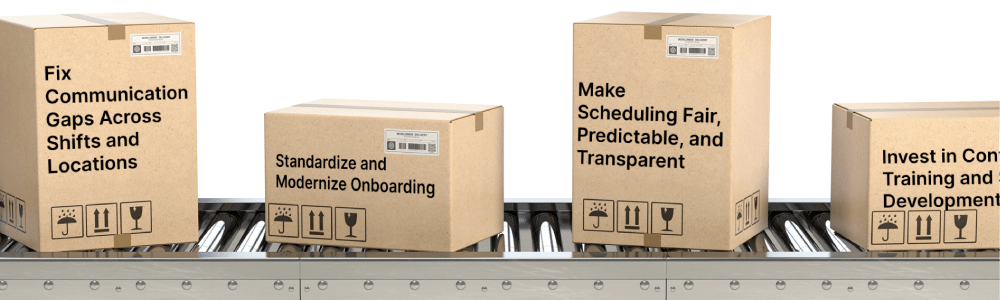
1. Fix Communication Gaps Across Shifts and Locations
Information in manufacturing environments tends to travel through managers. When managers are stretched thin or communication is inconsistent, information stops flowing. Workers on the night shift may be operating from different assumptions than those on days, or workers at one facility may be unaware of changes already in effect elsewhere.
The structural fix is making information less dependent on any individual manager’s bandwidth. Digital tools that reach workers directly, shift-start briefings, and posted updates that are actually current all reduce the gap. The goal is deploying communication that reaches the people it is meant for.
2. Standardize and Modernize Onboarding
Onboarding in manufacturing often means “spend a few days with someone experienced.” That is informal knowledge transfer, not onboarding, and it produces results that vary entirely based on who the new hire ends up following. A structured sequence removes that variability and also reduces the burden on experienced workers who are otherwise expected to train people on top of their regular job. Which is, incidentally, its own retention risk.
A structured onboarding sequence covers safety protocols in a defined order, equipment orientation with clear checkpoints, and compliance requirements tracked to completion—so that every new hire gets the same foundation regardless of which shift they start on or which supervisor happens to have bandwidth that week.
3. Make Scheduling Fair, Predictable, and Transparent
Few things erode trust faster than feeling like the schedule is arbitrary. Workers who cannot predict their hours with reasonable confidence cannot plan their lives, and that frustration compounds quickly. Scheduling disputes, last-minute shift changes, and perceived favoritism in assignment are consistent themes in manufacturing exit conversations.
Predictability does not mean rigidity. It means workers understand how scheduling decisions are made and have confidence the process is consistent. A mechanism for raising concerns helps too, because being heard is part of the experience.
4. Invest in Continuous Training and Skill Development
Training in manufacturing tends to be front-loaded, then largely absent until something goes wrong. The workers who stay and perform at the highest level tend to be the ones who feel like they are still developing. A clear progression from entry-level to skilled operator, with training milestones attached to advancement, gives workers both a reason to stay and a measure of their own growth. It also has an operational return: a more skilled workforce makes fewer errors and adapts more readily when process or technology requirements change.
5. Improve Manager Effectiveness on the Floor
The direct supervisor is the single most influential variable in frontline employee experience—more so than pay, benefits, or the broader organizational culture. A good supervisor buffers workers from dysfunction above them. A poor one transmits it directly.
Most manufacturing supervisors were promoted because they were excellent at the technical job, which is not the same qualification set as managing people well. Investing in supervisor development and training is one of the higher-leverage moves available. It also signals to workers that their experience with their manager is something the organization considers worth addressing.
In practical terms, that investment does not need to be elaborate. Structured feedback frameworks, regular check-ins with their own managers, and clear expectations about how they communicate with their teams go a long way. The baseline for what counts as good people management on the floor is often lower than organizations realize, which means the improvement available from modest investment is higher than they expect.
6. Recognize Work in Real Time, Not Once a Year
Annual performance reviews are a reasonable mechanism for salary conversations. They are a poor mechanism for recognition, which works best when it is specific and close in time to the work being recognized.
Recognition in manufacturing does not require a sophisticated program. It requires managers who are in the habit of naming good work when they see it, and structures that make that easy. Shift-start acknowledgments, peer recognition, and visible team performance tracking all reinforce that good work is noticed. The bar is often lower than employers assume.
7. Digitize Manual Processes That Frustrate Employees
Paper-based HR processes in manufacturing are a particular category of friction. Forms go missing, approvals require tracking down a manager, and onboarding paperwork takes hours, creating a poor first impression for new hires and a frustrating experience.
Digitizing routine HR tasks, like scheduling requests, training completions, policy acknowledgments, and onboarding documents removes a specific and preventable category of friction. It also creates the compliance documentation trail automatically, without the manual effort of maintaining it. The employee experience improvements that follow tend to be disproportionate to the effort required; small changes have a big impact.
8. Listen to Employees and Act on Feedback
Surveys without follow-through are worse than no surveys. Workers who complete an engagement survey, see nothing change, and are asked to complete another one six months later are not a neutral data point. The feedback loop has to close. Workers who feel genuinely heard tend to stay and perform better than those who feel ignored, even when the answer is no.
The Role of Technology in Manufacturing Employee Experience
Technology alone does not improve the frontline experience. But without the right technology, improving it at scale is an uphill battle.
The specific problems technology addresses in manufacturing are coordination and visibility—making sure the right information reaches the right worker at the right time, and giving HR and operations leaders a clear picture of what is happening across shifts and locations. Rival Workflow handles that operational layer: onboarding sequences that run consistently for every new hire regardless of who is managing the process, automated compliance tracking, and communication workflows that reach workers directly. For manufacturing organizations managing frontline talent across multiple facilities and shift patterns, that consistency is the difference between an employee experience that is designed and one that varies by location and coordinator.
Measurement matters here too. Organizations that make progress on manufacturing employee experience tend to track it. The data surfaces where the experience is actually breaking, which is usually not where anyone expected.
Start Small but Stay Consistent with Employee Experience Improvements
The organizations that make meaningful progress on manufacturing employee experience are rarely the ones with the most ambitious programs. They are the ones that pick a few high-leverage areas, build the process to improve them, and sustain the effort.
Onboarding is usually the right place to start. It affects every new hire, shapes first impressions at a moment of genuine receptivity, and has a measurable effect on how quickly someone becomes a confident, capable contributor. Getting it right creates a foundation that subsequent improvements can build on.
From there, the changes that tend to stick are the ones that get embedded in normal operations rather than layered on top of them. Recognition that lives inside a separate program fades. Recognition that becomes part of how supervisors run their shifts persists. The goal is a better-functioning operation, staffed by skilled people who have good reasons to stay and bring their best.