
Nothing gets HR and IT aligned faster than realizing a former employee still has access to six systems, two shared drives, and probably Salesforce. It’s funny until someone finds out offboarding was managed through a spreadsheet, three email threads, and a “Hey, did this ever get done?” Slack message.

For most organizations, HR and IT are more interconnected than ever—even if their systems and workflows do not reflect it yet.
Every major employee transition now touches both teams:
- Recruiting and candidate data
- Onboarding and provisioning
- Compliance and policy management
- Leave and role changes
- Offboarding and access removal
- And increasingly, AI governance
But many organizations still manage those processes through disconnected HR IT systems, email chains, spreadsheets, ticket queues, and manual follow-ups. The result is operational friction everywhere:
- HR waits on IT to update workflows or reports
- IT gets pulled into administrative work it never intended to own
- Managers lack visibility into stalled tasks
- Employees experience delays during onboarding and offboarding
- Compliance gaps emerge between systems and teams
Ironically, many HR technology implementations make this problem worse. New systems often introduce:
- Additional integrations
- New reporting requests
- Ongoing workflow maintenance
- User administration
- Troubleshooting responsibilities
- Long-term support burdens for IT teams
The best HR IT solutions do the opposite. They reduce operational dependency on IT while still preserving IT’s oversight into security, governance, integrations, and compliance.
That shift matters because modern employee operations are too interconnected—and too fast-moving—to rely on disconnected workflows and manual coordination.
Where HR Technology Creates IT Friction
Most HR and IT teams are not struggling to coordinate because they lack good intentions. They are struggling because employee operations span too many disconnected systems.
Take onboarding as an example.
HR owns the employee experience:
- Welcome communications
- Forms
- Policy acknowledgments
- Training assignments
- Orientation
IT owns the access employees need to become productive:
- Laptops and equipment
- Credentials
- Permissions
- Application provisioning
In many organizations, those workflows still operate independently. HR completes onboarding tasks in one system. IT receives requests through tickets or emails. Managers track progress manually. Employees wait while teams coordinate behind the scenes.
The issue is rarely effort. The issue is orchestration.
When onboarding workflows are disconnected, everyone feels it:
- Employees arrive without access
- Managers lose productivity
- HR spends time chasing updates
- IT gets pulled into avoidable support escalations
Offboarding exposes the same problem in reverse. HR processes the separation. IT revokes access. Facilities recovers equipment. Payroll updates records. Managers complete transition tasks.
If those steps are not coordinated in real time, organizations create operational and security gaps between employee separation and system access removal, exposing themselves to compliance risks.
The same pattern appears across:
- Leave management
- Compliance tracking
- Role changes
- Contractor onboarding
- Acquisitions
- Reporting requests
Disconnected workflows create manual work. Manual work creates delays, visibility gaps, and support burden. Over time, IT becomes the operational backstop for processes it never intended to own.
What IT Actually Wants From HR Technology
When HR introduces new technology, IT concerns are often interpreted as resistance to change. In reality, most IT teams are trying to avoid inheriting long-term operational burden.
They do not want:
- Endless workflow update requests
- Manual integrations
- Constant troubleshooting
- Custom report generation
- Fragmented user administration
- Another system that increases ticket volume
What IT actually wants is much simpler:
- Secure integrations
- Governance visibility
- Auditability
- Reliable data flow
- Scalable administration
- Confidence that the system will not create operational chaos six months after implementation
That distinction matters. Modern HR IT systems should not require IT to become the day-to-day operator of HR processes.
The strongest operational models separate governance from operational ownership:
- IT validates security, integrations, connectivity, and compliance requirements
- HR manages workflows, automation, reporting, and employee operations directly
That allows both teams to focus on the work they are actually designed to do.
The organizations getting this right are not eliminating collaboration between HR and IT. They are reducing unnecessary operational dependency through better workflow orchestration.
What Orchestrated HR Workflows Look Like
Organizations with mature employee operations tend to approach workflows differently. Instead of treating onboarding, offboarding, compliance, and reporting as disconnected departmental tasks, they orchestrate those processes across systems and teams. That changes the operational experience significantly.
When a candidate accepts an offer, the HR IT onboarding process for new employees should already be in motion:
- Onboarding tasks trigger automatically
- Provisioning requests route to IT
- Training assignments deploy by role
- Managers receive setup checklists
- Payroll and HRIS records update in sequence
- Reminders and escalations happen automatically when something stalls
No one is manually coordinating the process through email chains and spreadsheets. The workflow keeps moving.
That same orchestration extends across the employee lifecycle:
- Leave requests
- Role changes
- Policy acknowledgments
- Compliance tracking
- Access removal
- Audit preparation
- Reporting visibility
The operational challenge is not usually knowing what needs to happen. It is coordinating who needs to do what, when, and across which systems. That is where orchestration changes the relationship between HR and IT.
Instead of relying on IT teams to manually coordinate workflows, generate reports, update forms, or troubleshoot disconnected processes, organizations build systems where workflows, integrations, approvals, and visibility are connected by design.
The result is:
- Fewer tickets
- Fewer manual follow-ups
- Fewer compliance gaps
- Less operational drag
- Significantly better visibility across teams
How Rival Reduces Operational Burden
Rival Workflow is designed to reduce operational friction between HR and IT—not increase it.
Instead of creating additional dependency on IT teams for workflow maintenance, reporting, integrations, and administration, Rival gives HR teams the ability to manage employee operations directly while preserving IT oversight into security, governance, and connectivity.
When a candidate accepts an offer, onboarding workflows trigger automatically. IT receives provisioning requests. Managers receive setup tasks. Training assignments deploy based on role and location. Payroll updates in sequence.
No one emails anyone. No one files a ticket. The workflow routes the right tasks to the right people at the right time—and escalates automatically when something stalls.
Healthcare organizations often feel these coordination challenges most acutely because onboarding delays can affect patient care, compliance, and system access simultaneously.
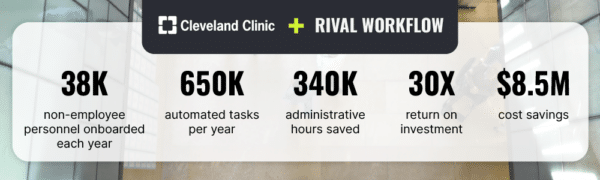
Cleveland Clinic uses Rival Workflow to coordinate onboarding for 38,000 non-employee personnel annually—including contractors, researchers, students, and volunteers with strict healthcare compliance requirements. The organization now automates approximately 650,000 tasks annually, saving 340,000 administrative hours and generating $8.5 million in cost savings with a reported 30x return on investment.
Offboarding workflows operate the same way in reverse.
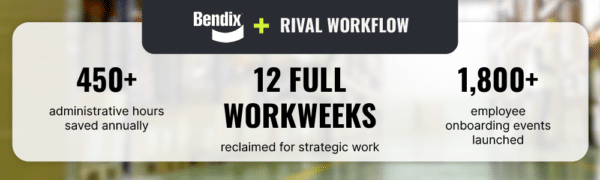
Bendix Commercial Vehicle Systems automatically alerts IT up to ten days before an employee departure to coordinate access removal and exit workflows across the United States, Mexico, and Canada—reclaiming more than 450 administrative hours annually in the process.
HR teams can configure region-specific workflows directly:
- Spanish-language forms in Mexico
- Province-specific requirements in Canada
- Localized compliance processes by region or business unit
Routine workflow updates no longer require lengthy IT projects or external consulting engagements.
Compliance activities such as I-9s, E-Verify, policy acknowledgments, certifications, and training requirements are enforced directly within workflows, with audit trails that document completion automatically.
Instead of chasing managers through emails and spreadsheets:
- Reminders trigger automatically
- Overdue tasks escalate automatically
- Reporting visibility already exists inside the workflow
Because Rival connects to the systems organizations already use—including HRIS, payroll, learning systems, IT service management platforms, and background check vendors—data flows automatically between systems as workflows progress.
IT teams maintain oversight into security, integrations, governance, connectivity, and audit readiness, but they are no longer forced to manage the day-to-day orchestration of HR operations.
ROSI, Rival’s built-in knowledge agent, extends that visibility even further. HR teams can identify stalled onboarding steps, overdue tasks, or emerging compliance gaps directly from live workflow data instead of manually building reports or chasing status updates across systems. Employees can ask ROSI about onboarding status, assigned tasks, upcoming steps, or company policies without generating additional HR or IT support tickets.
The result is a smoother employee experience, stronger compliance posture, fewer operational blind spots, and significantly less administrative burden for both HR and IT teams.
As employee operations become more complex—and AI, compliance, and cross-system coordination continue to expand—organizations need more than disconnected workflows and manual oversight.
They need orchestration built into the flow of work.