Most companies send a welcome email out to new hires. Most of them are nothing to write home about.
A welcome message to a new employee is the first real signal your organization sends after the offer is signed. What that message contains, when it arrives, and whether anything follows it up are not small details. They are basically the opening moves of an onboarding experience.
Seems like a pity to leave that to a generic form letter, no?
The problem is that most organizations treat the welcome email as a nice-to-have that is either a cut and paste, or gets drafted in a hurry, followed by a week of silence until day one arrives. The new hire, sitting at home with a signed offer and a lot of open questions, is left to wonder whether anyone is on the other end of that correspondence.
A better welcome is not just a slightly more personal letter. It is more of a conversation—a sequence of timed, personalized messages, that is connected to everything else happening in the onboarding workflow.
This article covers:
- What to put in a welcome message series
- Some templates worth borrowing
- The mistakes that quietly undermine first impressions
- How to turn a single email into a communication system that actually holds
A good welcome message covers the basics clearly and warmly. A good onboarding communication strategy sequences multiple touchpoints from offer acceptance through the first weeks of employment. The difference between those two things shows up in your 90-day retention numbers.
What to Include in a New Employee Welcome Message
The fundamentals of a welcome message and conversation are not complicated, but they get missed with surprising frequency. A welcome message that does its job covers five things. 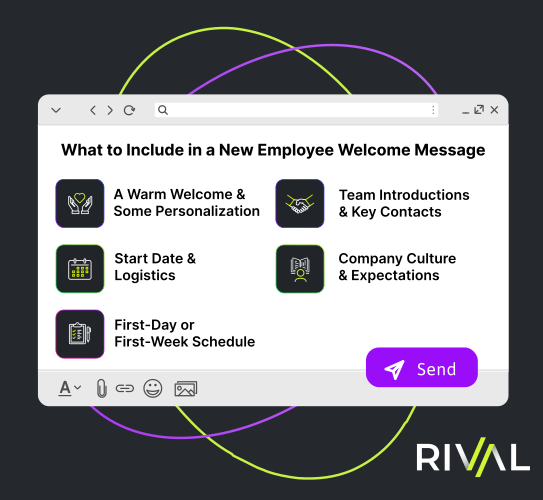
1. A Warm Welcome and Some Personalization
For someone who just made a career decision partly based on how they felt about your organization, going generic is a missed opportunity. Reference the role specifically. Mention something from the interview process if it applies. Have the message come from the hiring manager rather than a generic HR alias. The signal you are sending is: we noticed you specifically, and we are glad you are coming. That is not a high bar, but clearing it matters.
2. Start Date and Logistics
Where should your new hire be, at what time, and what should they bring? Who should they ask for? Is parking a thing they need to think about? Is it remote, on-site, or some combination on day one? These questions are sitting in the new hire’s head the moment they sign the offer. Answer them before they have to ask.
3. First-Day or First-Week Schedule
Even a rough outline is better than nothing. New hires are not expecting a minute-by-minute itinerary, but knowing whether day one involves a team lunch, a stack of compliance forms, or a meeting with the CEO helps them show up in the right frame of mind. Uncertainty about what to expect is its own form of friction, and it starts accumulating before day one.
4. Team Introductions and Key Contacts
Who will they be working with most closely? Who should they contact if something goes sideways before they start? A brief introduction to the immediate team is usually very welcome at this stage. Even if it’s just names and roles, it gives a new hire something to orient around. A buddy or point of contact for the first week is worth mentioning here too. Nobody enjoys arriving somewhere and not knowing who to talk to.
5. Company Culture and Expectations
You can get into the nitty-gritty of culture during orientation, but this is a good time for a sentence or two about what the team values, what a good first week looks like, or what they should prioritize absorbing early. It’s also a great time to ask questions: what’s their T-shirt size (for swag gifts)? What’s their cake flavor of choice (to include in the monthly birthday bash)? Giving a flavor of culture here also signals that the organization has thought about onboarding beyond paperwork, which itself makes an impression.
New Employee Welcome Email Examples
Templates are a starting point, so please don’t cut and paste these. Adjust them for your culture, and, for anything important, add the specifics that make it actually feel like your organization sent it.
Formal Welcome Email
Subject: Welcome to [Company Name], [First Name]
Dear [First Name],
On behalf of [Company Name], I am delighted to welcome you to the team. We are looking forward to having you join us as [Job Title] on [Start Date].
Please plan to arrive at [location / login instructions] by [time]. [Contact name] will meet you and help you get settled. Your first day will include [brief outline—e.g., orientation, team introductions, and time to get your systems set up].
In the meantime, please do not hesitate to reach out if you have any questions before you start. You can contact me directly at [email] or reach our HR team at [email].
We look forward to welcoming you properly on [Start Date].
Warm regards,
[Manager Name]
[Title], [Company Name]
Friendly Welcome Message
Subject: So glad you’re joining us, [First Name]!
Hi [First Name],
We are so excited that you are joining [Company Name]! The team has been looking forward to your start date since we got the news.
A few things to know before you arrive:
- You will be starting on [Start Date] at [time].
- Come to [location / log in to X], and [buddy / contact name] will be there to get you oriented.
- Your first week will be a mix of [brief description], with plenty of time built in to meet the team and get comfortable.
If anything comes up before then, just reply here or reach out to [contact]. We want day one to feel easy.
See you soon,
[Manager Name]
Short Welcome Message for Quick Communication
Subject: See you on [Start Date], [First Name]
Hi [First Name],
Sending a quick note to say welcome! We are very glad you are joining. You are starting on [Start Date] at [time], reporting to [location / platform]. [Contact name] will be your first point of contact.
More detail will follow, but I wanted to make sure you had the essentials. Any questions before then, just reach out.
Looking forward to it,
[Manager Name]
Common Mistakes When Welcoming New Employees
The welcome email fails more often by omission than by anything dramatic. These are the patterns worth watching for.
Sending Generic, Impersonal Messages
A message that could have been sent to anyone feels like/lands like a message sent to no one. If the new hire’s name and role could be swapped out without changing a word, something is missing. Personalization requires enough specificity that the person reading it believes someone actually wrote it for them.
Missing Key Information
Logistics matter more than tone in the first message. A warmly written email that does not tell the new hire where to show up, what to bring, or who to contact is lovely and useless. Answer the practical questions first. The warmth can come alongside them.
Poor Timing or Delays
Be prompt! A welcome email that arrives three days after the offer is signed is an afterthought. The gap between offer acceptance and first contact is the period when new hires are most susceptible to second-guessing their decision, fielding counteroffers, and generally wondering if the organization is as organized as it seemed during the interview. Getting a message out within 24 hours of the signed offer is the baseline. Earlier is better.
Lack of Follow-Up Communication
The follow-through is where most onboarding communication strategies fall down. A single message is not an onboarding communication strategy. It is a starting point that needs a sequence attached to it. Keep the conversation going.
Why One Welcome Message Is Not Enough
The offer-to-start period is an operational window that many organizations waste. Between the signed offer and day one, a new hire has time, attention, and genuine interest in learning about their new employer. Take advantage of it before they start drinking from the firehose.
A well-sequenced preboarding and onboarding communication strategy looks more like this:
- A welcome message goes out within 24 hours of offer acceptance.
- A preboarding email follows with practical information like forms to complete, systems to set up, and answers to the questions everyone asks.
- A first-day confirmation arrives a few days before start.
- A check-in message lands at the end of week one.
- A 30-day touchpoint follows.
Each message is timed, purposeful, and connected to whatever else is happening in the onboarding process.
This is where most onboarding communication fails. It may seem simple to send or even schedule a few emails, but without a workflow holding the sequence together, messages get missed. Timing is inconsistent. Some new hires get a thorough preboarding experience; others get one email and radio silence. HR has no visibility into what has been sent, what has been read and engaged with, or what is outstanding. The new hire experience ends up varying by coordinator, by hiring manager, or by how busy the team was that week—which is a strange thing to leave to chance when you have just spent weeks recruiting someone.
Rival Workflow orchestrates the sequence so the communication happens reliably, regardless of who is managing the hire. The right message goes out at the right time, connected to the tasks and milestones that define the broader onboarding journey, not sitting in a separate email thread that nobody is monitoring.
How to Turn Welcome Messages into an Onboarding Workflow
Getting this right is mostly a design problem. Here is how to approach it.
Define Communication Triggers
Every message in the sequence should be attached to an event, not a calendar reminder in someone’s personal calendar. Offer signing triggers the welcome email. Start Date minus seven days triggers the logistics confirmation. Day One completion triggers the Week One check-in. When the triggers are defined, the messages go out whether or not anyone remembered to send them.
Automate Message Sequencing
Once the triggers are set, the sequence should run without manual intervention. This is not about removing the human element from communication. The messages should still sound like they came from a person. It is about removing the dependency on someone remembering to send them at the right moment, which is a dependency that fails regularly and invisibly.
Assign Ownership
Different messages belong to different senders. The initial welcome is most effective from the hiring manager. Logistics and paperwork can come from HR. A Week One check-in might come from a buddy or team lead. Defining ownership explicitly (and building it into the workflow) means the right person sends the right message, rather than everything defaulting to a generic HR inbox.
Personalize at Scale
Personalization at scale is a workflow problem, not a writing problem. Templates with dynamic fields that pull in the new hire’s name, role, start date, manager, and team mean every message feels specific without anyone drafting from scratch. The pre-onboarding email that arrives two weeks before start should not look identical for a software engineer and a sales coordinator—and with the right workflow structure, it does not have to.
Track Engagement and Completion
Sending a message is not the same as a new hire receiving and acting on it. Visibility into what has been opened, what tasks have been completed, and where someone is in the onboarding journey allows HR to catch problems before they become gaps. Who hasn’t completed their I-9? Who hasn’t logged into the onboarding portal? These are questions that should have instant answers, not require someone to dig through sent mail.
Welcome New Employees Consistently with Rival Workflow
The welcome email is where onboarding communication starts.
Rival Workflow is where an onboarding checklist becomes a system.
Rival orchestrates the full sequence of onboarding communication—from the first preboarding message through 30-, 60-, and 90-day touchpoints—alongside every task, form, and approval that runs parallel to it. Messages are triggered automatically, assigned to the right senders, personalized for the role and individual, and connected to the broader onboarding journey rather than floating in a separate email thread. When a task is completed, the next step fires. When something stalls, it surfaces.
ROSI, Rival’s conversational AI, gives HR instant visibility into where any new hire stands without running a report or chasing a coordinator. For organizations onboarding at volume, across multiple locations and role types, that kind of visibility is what separates a consistent new hire experience from one that varies by who happened to be in the office that week.
A good welcome message takes twenty minutes to write. A welcome message that reliably reaches every new hire, at the right moment, followed by the right sequence of communication and tasks, takes a workflow.