
Culture starts earlier than most companies think
Companies love to talk about culture once an employee is in the building.
From day one, it’s all values decks and manager toolkits and speeches about belonging. But culture actually shows up a whole lot earlier.
A lot of organizations still treat the period between offer acceptance and start date like administrative filler, useful for paperwork, maybe a background check, or a welcome email (if somebody remembers).
There is a pretty obvious problem with that timeline: by the time someone reaches day one, they have already started forming an opinion about your company’s culture.
To the person on the receiving end, that stretch is the first lived experience of your company. It is where the promise of working there either starts to feel real or the sound of crickets causes buyer’s remorse.
Gallup has noted that the decision to join a new organization is only 30% rational and 70% emotional, which is exactly why this moment matters so much. It’s one of the few times in the employee lifecycle when expectations, emotions, and risk are all unusually concentrated.
The employer is hoping the person shows up excited and ready. The employee is hoping they made the right decision. Both sides have something to lose, and both sides are paying closer attention than they may admit.
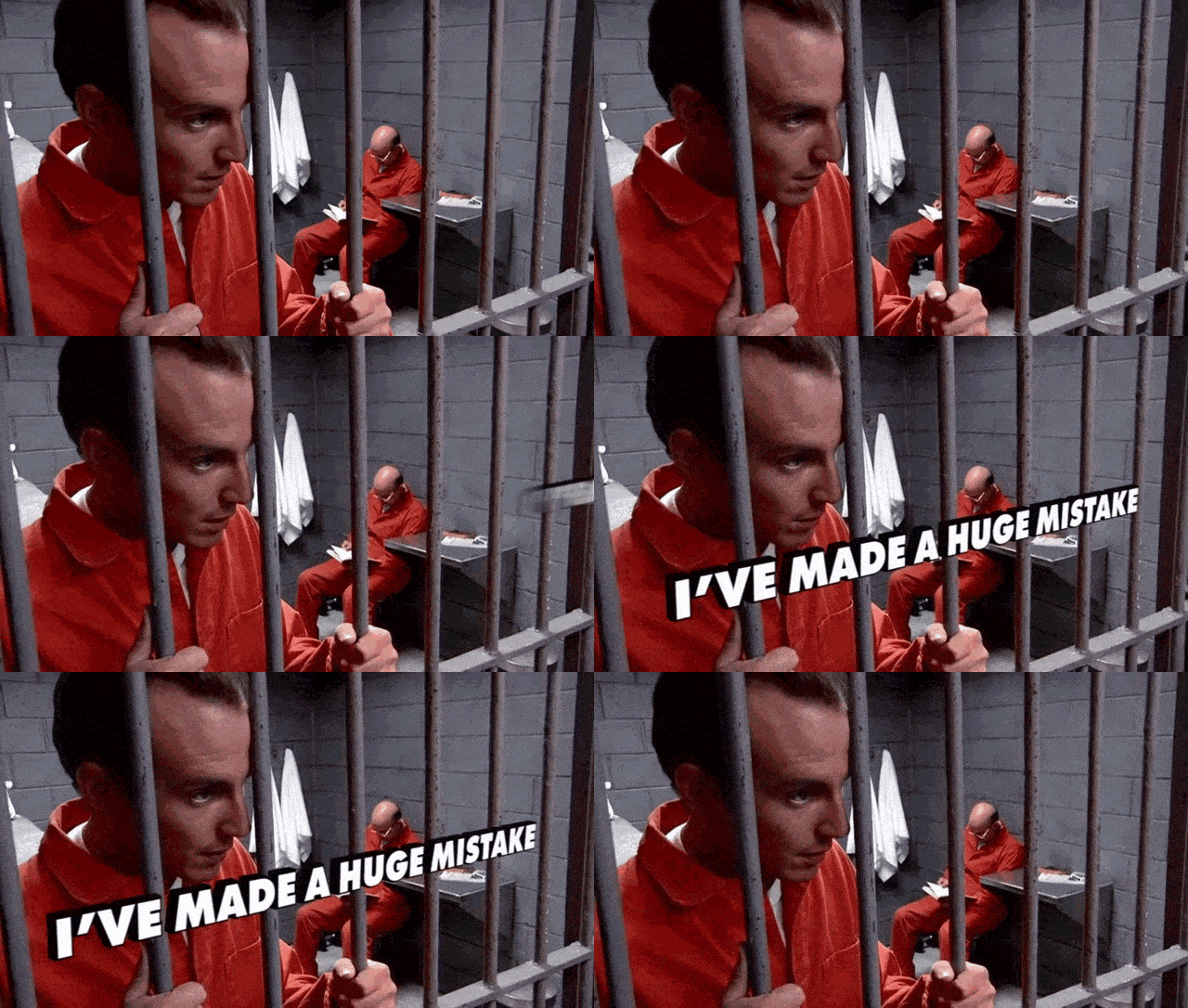
New hires are not just waiting around for day one to have feelings about their new workplace. They are watching, interpreting, and deciding whether this already feels like a smart move or whether—in the words of Gob Bluth—they’ve made a huge mistake.
The space between “yes” and day one is not neutral
Culture is not the poster in the hallway. It’s not the line on the careers page about people being your greatest asset. It’s not the slide at orientation with words like integrity and collaboration floating in tasteful brand colors.
Culture, at its most basic level, is what people come to expect from the way your company behaves. And that starts long before day 1.
This is where the usual framing around preboarding often falls short. When companies talk about it at all, they tend to talk about it like a setup checklist. Internally, it looks procedural. Externally, it feels impersonal.
That disconnect between the administrative tasks that need to happen and what the new hire experiences creates all kinds of blind spots. Recruiting thinks the handoff is done. HR thinks it is time to send forms. The manager assumes there will be time to connect later. The employee thinks, I am not entirely sure who is expecting me, what happens next, or who I talk to if something goes sideways.
It does not take a dramatic failure to shake confidence. More often it is the smaller stuff that does it: the silence, the duplication, the vagueness, or the sense that nobody is ready for their arrival.
Why weak preboarding creates real business risk
This is not just an optics problem.
This is a particular concern in a hiring environment where post-hire no-shows (or ghosting) is increasingly a real issue, especially in industries like healthcare, retail, and hospitality. And while no-show rates never come down to one single cause, weak preboarding clearly does not help. SHRM has pointed to communication failures as a major driver of candidate ghosting and drop-off, which makes the silence or confusion after offer acceptance more than a minor annoyance. It creates room for doubt at exactly the wrong time.
Even when the employee does show up, a shaky start has consequences. They may smile through orientation and technically begin, but the confidence that should have been building is flatter than it ought to be. Trust has not deepened; it has been deferred. Instead of arriving with a growing sense that this was a smart decision, they arrive hoping it becomes one.
That is not a great foundation for the first 90 days.
Preboarding is not paperwork. It is proof.
What good companies understand is that preboarding is not just there to move information. It is there to create confidence.
That proof does not have to be elaborate. In fact, it is usually better when it is not. Nobody needs a swag box stuffed with branded nonsense to feel welcomed by an employer (though if you offer this in addition to thoughtful preboarding, then more power to you). What people need is simpler and far more useful: clarity, continuity, and some evidence that other humans are expecting them.
That distinction fits squarely with Rival’s own way of thinking about culture. We believe culture erodes when clarity fades, communication slips, and employees are left to navigate change without understanding what it means for them. Culture is not a perk. It is a system. It lives in the everyday processes people experience, not just in the slogans leaders plop on slides.
The same logic applies here. Preboarding is one of the first places employees get to see whether your systems are actually worthy of the trust you are asking them to place in you.
What strong preboarding should actually do
A strong preboarding experience does not need to be elaborate. It just needs to reduce unnecessary doubt.
It should answer obvious questions before they become anxieties. It should make next steps visible without making the employee hunt. It should connect recruiting, HR, IT, and the manager in a way that feels like one experience rather than a relay race with bad handoffs. And it should give the new hire some signal—preferably before the first day, not halfway through it—that other humans are expecting them.
Dr. Talya Bauer’s 4 C’s of onboarding, developed for SHRM, makes a similar point: the work is not just compliance. It is also clarification, connection, and culture. That is why the real question here is not whether the forms got sent. It is whether the experience supports what the company claims to value.
If you say you care about people, does the process respect their time and attention? If you say managers are central to the employee experience, do they appear before day one or only after something goes sideways? If you say your technology helps HR work smarter, does the journey feel connected and intuitive, or does it feel like your stack is quietly taking revenge on everyone who has to use it?
Culture is built in systems, not words
Companies spend a lot of time and money attracting the right people. They polish employer brand, refine the candidate journey, and work hard to get to yes. Then some of them treat the period immediately after yes like momentum will simply take care of itself.
It will not.
If culture starts before day one, then preboarding needs to do more than move forms around and hope for the best.
A strong preboarding process should make the experience feel coordinated, not cobbled together. It should make expectations clear, surface the right information at the right time, and give managers, HR, and IT a shared way to move the employee from offer acceptance to first day without making the new hire do the stitching.
In practical terms, that means a few things:
1. Create a clear journey between hire and start.
First, the new hire should never be guessing about next steps. They should know what happens next, when it happens, and who is responsible. If there are forms to complete, great. If there are devices to ship, accounts to provision, introductions to make, or compliance tasks to finish, great. But the process should feel like one guided sequence, not a scavenger hunt across inboxes, spreadsheets, and crossed fingers.
2. Make sure managers show up before day one, not just after it.
Culture does not become real when HR sends the packet. It becomes real when the organization behaves like an actual group of humans is expecting this person to arrive. That can be as simple as prompting a manager note, a first-week outline, a team introduction, or a short message that says, clearly, “We are ready for you.” Small gestures, big impact.
3. Preboarding should reduce friction for the people running it too.
HR should not be manually chasing every signature, checking every status in three systems, and forwarding updates between recruiting, IT, payroll, and managers like an overworked air traffic controller. If the process depends on heroic follow-up from one or two people, it is not a process. It is an improvisation.
Why workflow matters here
The point of a good workflow is consistency. It is making sure the experience employees have matches the company your leaders think they are running. It is making sure every stakeholder knows what happens next, every task moves when it should, every document lands where it belongs, and every new hire gets a more connected, more confident start.
That is also where Rival Workflow earns its place in this conversation.
Because if culture is built in systems, then the systems themselves need to do some actual work. Rival Workflow helps HR teams turn preboarding from a loose collection of reminders, handoffs, and “did anyone ever send that?” into a structured experience that moves. Tasks can be triggered automatically. The right people can be notified at the right time. Forms, approvals, document collection, provisioning steps, and communication can all live inside one coordinated flow instead of being scattered across disconnected tools and good intentions.
That does not just make life easier for HR. It makes the experience better for the employee.
And that, ultimately, is the point. Good preboarding should not feel like an administrative gap between recruiting and onboarding. It should feel like the beginning of joining the company. It should build confidence, reduce uncertainty, and show the employee, in concrete terms, that this organization is capable of follow-through.
Setting culture before day one
Companies spend a lot of time talking about culture as if it starts once the employee is seated, badged, and halfway through orientation. But by then, the employee has already been learning who you are.
That is why culture should start before day one.
And if you want it to, you cannot leave preboarding to good intentions and loose ends. You need a process that actually supports the experience you claim to value. Done well, it is one of the simplest ways to build trust before the first day even begins.