Preboarding is everything that happens after a candidate accepts your offer and before their first day—and it’s one of the most underestimated moments in the entire employee journey.
Most organizations invest heavily in recruiting and onboarding, but treat the space in between as administrative limbo. Documents get emailed. Equipment requests get forwarded. New hires wait, unsure what they should be doing, or whether they’ve already missed something important.
That gap matters.
Preboarding is when new hires start forming opinions about your organization. It’s when expectations are set (or left unclear). A clear preboarding checklist leveraging HR workflow automation changes that. It turns a high-stakes transition into a structured, repeatable process, so HR teams stay aligned, managers know what’s expected, and new hires arrive ready instead of anxious.
This article focuses on the checklist itself: a practical, ready-to-use view of what needs to happen between offer acceptance and day one. It’s a simplified slice of Rival’s broader 8-step preboarding framework, designed to be immediately useful whether you’re formalizing your process for the first time or tightening what you already have.
TL;DR:
Preboarding should start the moment the offer is signed, not the day your new hire shows up at the door. Having a clear checklist (ideally automated) will help reduce errors, save time, and make sure your new hires arrive on Day 1 confident instead of confused.
How to create a preboarding checklist for new hires
Before jumping into a new employee onboarding checklist,you first must focus on what needs to be done between offer signed and day one. The best preboarding checklists don’t try to do everything. Instead, they focus on clarity, ownership, and timing.
Identify who’s responsible
One of the most common reasons preboarding falls short is lack of ownership. A strong preboarding checklist makes responsibility explicit.
HR typically owns compliance, documentation, and the overall process. IT handles systems, tools, and equipment. The hiring manager owns connection, context, and early relationship-building. When each task has a clear owner, the checklist becomes a coordination tool instead of a wish list.
Cover four categories: communication, compliance, setup, and culture
It’s tempting to over-engineer preboarding. Resist that urge. Nearly every effective preboarding checklist falls into one of four simple core categories:
- Communication: What does the new hire need to know before day one? Start dates, schedules, where to show up (or how to log in), and who to contact with questions should never be a mystery.
- Compliance: This includes contracts, tax forms, IDs, and any legally required documentation. These tasks are essential, but they shouldn’t dominate the entire experience.
- Setup: This covers tools, systems, equipment, and access. When setup goes wrong, it derails day one faster than anything else.
- Culture: This is where preboarding shifts from transactional to intentional. Making introductions and sharing values establishes early human connection, like sending a meet-the-team video.
If a task doesn’t clearly support one of these areas, it’s probably not essential for preboarding, and can wait until onboarding.
Digitize the checklist
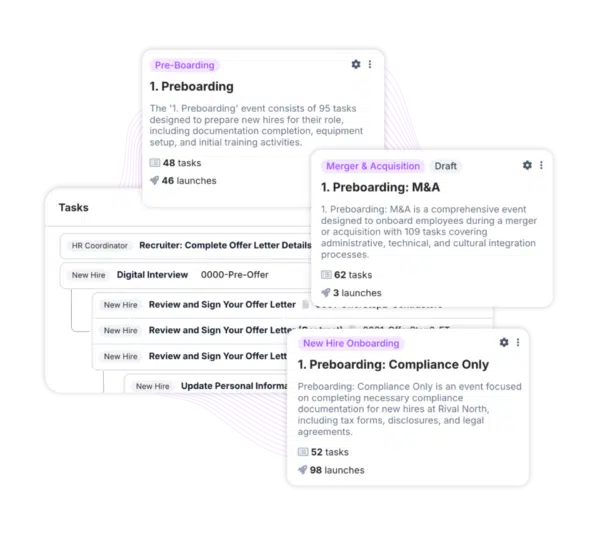
If your preboarding process lives in a shared doc, an email chain, or someone’s memory, it’s fragile by design. Digitizing your preboarding checklist allows actions to happen automatically instead of manually. Welcome emails can be sent as soon as an offer is accepted. Tasks can be assigned to the right people without follow-up. Progress can be tracked without HR chasing updates across teams.
If you’re automating HR processes with Rival Workflow, you can turn preboarding into a living process instead of reinventing the wheel every time. Workflows trigger when key events happen—like an offer being signed—and guide each step forward, consistently and reliably.
Ready-to-use preboarding checklist for the employer
Now let’s get practical. The employer-side preboarding checklist focuses on readiness. Its job is to ensure that by the time a new hire starts, everything works and everyone knows their role.
1. Prepare the essentials
Preboarding should begin immediately after offer acceptance. This is when momentum is highest, and when delays feel most noticeable.
- Start by confirming the offer details in writing and sharing all required employment documents. Contracts, tax forms, and identification requests should be clear, timely, and easy to complete.
- This is also the moment to initiate payroll setup and create the employee record in your HR system. Handled well, this stage reassures the new hire that everything is official and moving forward. Handled poorly, it creates uncertainty before day one even arrives.
Automation helps here by sending documents automatically, tracking completion, and prompting follow-ups only when something is actually missing.
2. Set up tools and workspace
During preboarding…
- Employers should ensure that laptops and equipment are ordered early, delivery timelines are confirmed, and system accounts are created with the right permissions.
- Email access, collaboration tools, and role-specific software should all be tested before the start date, instead of during their busy first morning.
3. Communicate early and often
Silence from an employer after an offer is accepted often gets misread as disorganization or disinterest.
- Preboarding is the right time to send a genuine welcome message, outline what day one will look like, and share any helpful context about the company.
- This might include a branded welcome package, culture guide, employee handbook, or a brief note from the hiring manager.
- The goal isn’t to overwhelm, but to orient. Clear communication during preboarding reduces anxiety and helps new hires arrive feeling prepared rather than uncertain.
At this stage, even small gestures matter. A personal note, an introduction to a buddy, or a simple “Here’s what to expect” message can shape how someone feels about your organization before they ever log in.
4. Prepare the team
One of the most overlooked steps in preboarding is internal alignment. Teams often find out a new colleague is starting when they show up on a calendar invite, or worse, when they show up in person. That’s a missed opportunity.
- Before day one, the broader team should know who’s joining, when they’re starting, and what role they’ll be playing.
- Managers should identify an onboarding buddy or informal point of contact.
- Intro meetings or a welcome lunch can be added to calendars in advance, so the first week doesn’t feel like a scheduling scramble.
This kind of preparation sends a quiet but powerful message: we planned for you. And that sense of readiness carries directly into engagement, confidence, and early productivity.
5. Automate and track progress
Even the best checklist breaks down if no one knows what’s done and what isn’t. That’s why the final step in any employer preboarding checklist is visibility. HR teams need a way to see progress at a glance, catch gaps early, and avoid chasing updates across email, Slack, and spreadsheets.
When preboarding is automated, progress tracking happens automatically. Tasks are assigned when triggers fire. Reminders go out only when needed. And everyone involved—HR, IT, managers—can see exactly where things stand.
This is where tools like Rival Workflow turn a simple checklist into a standard, consistent system. Instead of relying on memory or manual follow-ups, preboarding becomes a reliable, repeatable process that runs the same way every time, no matter how many new hires you’re bringing on.
Ready-to-use preboarding checklist for new starters
Preboarding works best when it’s a two-way street. While employers are setting up systems and preparing teams, new hires also benefit from having a clear view of what’s expected of them before day one. A dedicated preboarding checklist for new starters removes guesswork and helps people feel prepared instead of passive. Use this as a starting point:
1. Review key information
1. Review key information
- Before day one, new starters should be able to easily confirm their start date, schedule, location (or login instructions), and who to contact with questions.
- Any required paperwork should be completed promptly, without confusion about what’s mandatory and what’s optional.
- This is also the moment for new hires to save important contact details—HR, their manager, or their onboarding buddy—so they’re never unsure who to reach out to.
Clear information reduces first-day nerves and replaces uncertainty with confidence.
2. Set up for success
Preboarding gives new hires a chance to hit the ground running without expecting them to do real work before they start.
- Testing access to email or collaboration tools ahead of time can prevent day-one technical hiccups.
- Reviewing company policies or the employee handbook helps set expectations early.
- Preparing any necessary ID or security information in advance avoids delays once onboarding officially begins.
When these steps are guided and well-timed, new hires arrive focused on learning, not troubleshooting.
3. Learn the culture
This is the ideal time for new hires to get a feel for the organization’s values, mission, and tone.
- Reading a short culture guide, exploring internal platforms, or following the company on social media helps put faces and context to names.
- Some organizations invite new hires into pre-start Slack channels or send brief team introductions.
- Others share stories about how work actually gets done.
None of this needs to be heavy, but it should feel human.
4. Engage before day one
New hires can connect with their manager or onboarding buddy with a quick introduction.
- They may be invited to a virtual meet-and-greet or an informal Q&A before their first official day.
- Some teams encourage new starters to reflect on first-month goals or learning priorities, so those conversations are easier once work begins.
These small moments of engagement turn preboarding from a checklist into a welcome and help new hires feel like part of the team before they’ve logged their first hour.
Why automating your preboarding checklist matters
Preboarding works best when it removes uncertainty for everyone involved.
A strong checklist ensures the essentials are handled, teams are aligned, and new hires know exactly what to expect before day one. It gets paperwork and setup out of the way early, so onboarding can focus on learning, connection, and momentum, not damage control.
But checklists are only the starting point.
If you’re looking to go deeper—beyond task lists to a repeatable, scalable preboarding system—Rival’s Ready Before Day One: A Guide to Preboarding lays out a complete framework. It includes an 8-step approach, role-based checklists, first-week preview templates, and the metrics that help HR teams track readiness and reduce risk before day one arrives.
If you’re ready to automate that framework and get started with automated preboarding, download the guide now.