
HR teams have never had more software than they do today. Most organizations have some combination of HRIS, applicant tracking system, payroll software, learning platforms, engagement tools, compliance systems, and maybe a handful of other point solutions layered on top.
On paper, it looks like a very automated stack.
And yet, if you follow the actual work that happens inside HR, you’ll find something strange. The most important processes still depend heavily on people chasing things down.
A new hire joins and someone in HR has to nudge IT to set up access. A manager forgets to approve a request, so the process stalls until someone sends a reminder. An internal transfer requires a flurry of emails to make sure payroll, benefits, and reporting structures all update correctly. Offboarding sometimes becomes a small project involving spreadsheets, checklists, and a few panicked Slack messages.
None of this happens because HR teams are disorganized. In fact, most of them have carefully designed processes. They know what steps should happen and in what order. The problem is that knowing the process is not the same thing as keeping the work moving.
Most organizations don’t have a process problem.
They’re experiencing app fatigue. More tools, more AI, and more work leaves HR teams feeling burnt out.
Processes describe work. Workflows make it happen.
Nearly every HR team already has documented processes. But processes are descriptive. They explain what should happen. They don’t ensure that it actually does.
In the day-to-day reality of work, progress often depends on someone noticing that the next step needs to occur. Someone has to send the reminder, trigger the handoff, or check whether a task has been completed. If that person is busy, or simply unaware that the process stalled, the entire sequence slows down.
Over time, the process quietly morphs into a series of manual follow-ups. And by that point, you don’t really have an automated process. You have what could politely be described as human middleware. A whole lot of manual work — and opportunities for things to fall into the black hole.
A workflow is something different. Did you catch the “flow” part of that term? Instead of relying on people to push the process forward, a workflow actually drives the sequence. It routes requests, prompts approvals, triggers tasks across departments, and alerts the right people when something needs attention. In other words, it injects action into the process so that work continues moving even when no one is actively managing it.
That distinction between describing work and actually moving it forward is where many HR technology stacks trip and fall.
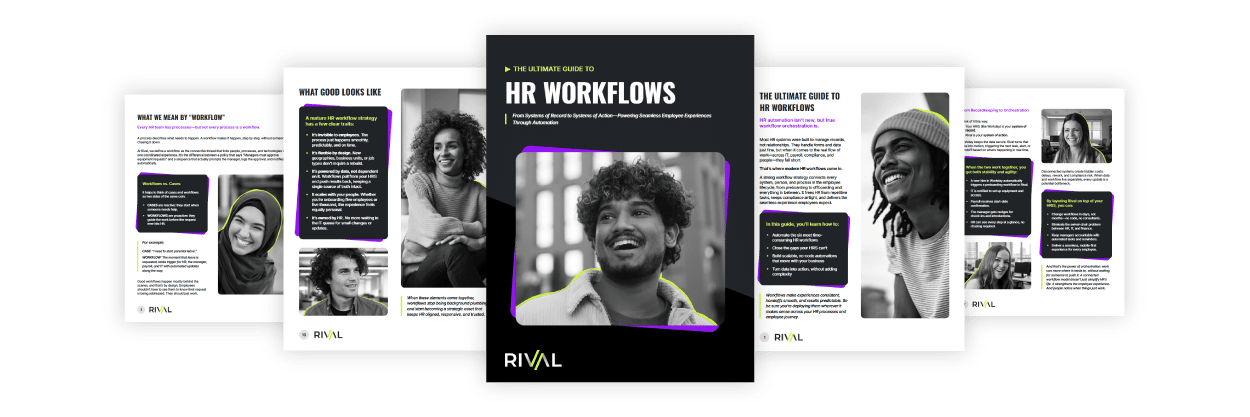
Learn more about workflows in our Ultimate Guide to HR Workflows.
The awkward truth about most HR systems
This isn’t a criticism of HRIS platforms. They are excellent at what they were designed to do.
An HRIS is fundamentally a system of record. It tracks employee data, stores job information, maintains reporting structures, and captures the official state of the workforce at any given moment. Without it, HR operations would be chaos.
But systems of record are not the same thing as systems that orchestrate work.
When an employee joins the company, moves into a new role, requests leave, or exits the organization, that event triggers a chain reaction across departments. Most HR systems capture the data associated with those events. They know that the change happened. But the coordination layer falls to that human middleware.
And everyone’s job gets a little harder.
Where the lack of momentum hurts
You can usually spot the absence of workflow acceleration in the places where HR processes cross departmental boundaries. That’s where coordination matters most, and where things are most likely to slow down.
Onboarding
Consider onboarding. Almost every company has a checklist that explains how onboarding should work. But in practice, the process often depends on someone making sure the next step actually happens. HR creates the employee record, then needs to notify IT. A manager has to submit equipment requests. Payroll needs to confirm compensation. Facilities may need to prepare workspace access. Each step involves a different person, system, or team.
If the handoffs are manual, the entire experience becomes fragile. One missed notification or delayed approval can slow down the employee’s first week before it even begins.
Offboarding
Offboarding creates similar complexity, but with higher stakes. When someone leaves the company, system access needs to be revoked, benefits may need to be updated, final pay must be processed, and compliance requirements must be met. If those steps aren’t coordinated carefully, the risks move from minor inconvenience to operational and security exposure.
Internal Moves
Internal moves are another common friction point. Promotions, transfers, and role changes often require updates across multiple systems and departments. Without a workflow layer guiding the sequence, HR teams frequently find themselves double-checking whether everything actually updated the way it should.
Compliance
Even recurring compliance requirements follow the same pattern. Certifications expire, training deadlines approach, and policies need acknowledgment. These are predictable events, but they still rely surprisingly often on calendar reminders and manual follow-up.
The missing acceleration layer in your HR tech stack
This is where workflows become important. Instead of replacing existing systems, they sit alongside them and orchestrate the actions that occur when something changes.
When a new hire is created in the HRIS, the workflow automatically triggers the tasks that follow. When someone changes roles, the right teams are notified and approvals move through the proper channels. When certifications expire, the system prompts completion and tracks progress.
The point isn’t to automate every task in HR, but to remove the friction that slows down predictable work so that people don’t have to spend their time chasing the process forward.
Once that workflow layer exists, your human middleware layer can refocus its efforts. All the administrative energy that used to go toward coordination can be redirected toward higher-value work: improving employee experience, refining programs, and solving the human problems that software alone can’t address.
In other words, the technology stack starts doing what it was supposed to do in the first place: accelerating work instead of creating more of it.
If this problem sounds familiar…
If any of this is a little too recognizable, you’re not alone. Most HR teams eventually discover that adding more tools doesn’t automatically make work flow better. In many cases, the opposite happens: the stack grows, but the coordination layer never materializes.
That’s exactly why we put together The Ultimate Guide to HR Workflows.
The guide breaks down what workflows actually are (and what they aren’t), how to identify where momentum is being lost inside your HR processes, and which workflows typically create the biggest impact first. It also walks through how organizations can build a workflow strategy that works with their existing HR systems rather than trying to replace them.
If you’ve ever looked at your HR tech stack and thought, “We have the systems… so why does so much of this still feel manual?”, this guide will help you unpack what’s really happening.
Because in most cases, your HRIS isn’t really broken. It’s just not built to do this alone.