Key themes from our recent HRCI webinar
HR teams are under growing pressure to deliver outcomes, like faster hiring, smoother onboarding, lower early attrition, and real workforce readiness. But many are trying to meet those expectations with data spread across disconnected systems, manual work that keeps piling up, and technology that doesn’t drive work forward.
That tension was at the center of our recent Rival-sponsored HRCI webinar, Building the Connected HR Ecosystem Behind Today’s Most Effective People Teams.
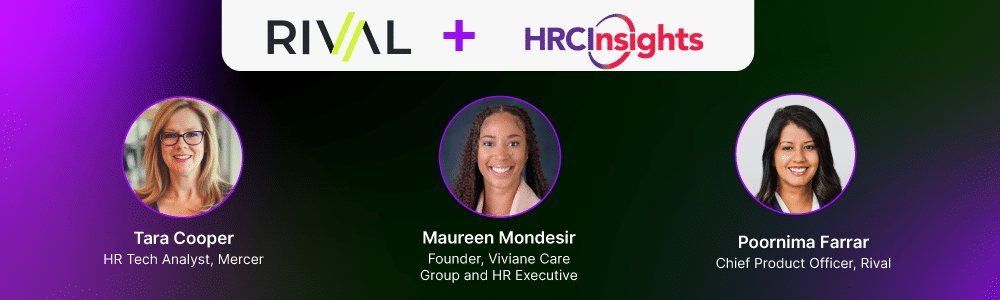
The lively conversation brought together three complementary perspectives on where HR is headed, and what’s getting in the way:
- Tara Cooper, HR Tech Analyst at Mercer, shared research-backed insight into why traditional HR operating models are struggling to keep pace with AI, constant change, and rising expectations.
- Maureen Mondesir, Founder of Viviane Care Group, grounded the discussion in lived HR leadership experience, where trust, care, and execution speed are daily requirements.
- Poornima Farrar, Chief Product Officer at Rival, spoke to what HR teams are being asked to deliver today, and how disconnected data and workflows slow even the best teams down.
The Challenges HR is Facing
Rather than focusing on tools or trends, the conversation centered on a few recurring realities HR leaders are grappling with right now:
- Disconnected systems are driving unnecessary work.
Across hiring, onboarding, compliance, payroll, and benefits, fragmentation forces HR teams to re-enter data, reconcile systems, and double-check work. The result is inefficiency, delay, frustration, and increased risk. - Manual work is crowding out higher-value work.
Live audience polling reinforced a familiar pain point: too much time is spent on repetitive, administrative tasks, leaving less time for judgment, problem-solving, and human connection—the work HR leaders actually want to be doing. - AI is creating urgency—and uncertainty.
Many organizations feel pressure to adopt AI quickly, often before they trust their data or agree on the outcomes they’re trying to improve. The panel emphasized that without connected data and clear governance, AI can just scale existing problems faster. - Some moments should stay human-led.
While automation can and should handle routine tasks, decisions that affect dignity, life events, or trust require human accountability. The goal isn’t removing people from HR, but protecting the moments where people matter most.
 HR.com found that 30% of HR teams are held back due to disconnected systems, and they’re not even able to really think through their key goals because the system is creating so much [extra] work.

Maureen Mondesir
Founder, Viviane Care Group & HR Executive
As these challenges took shape, the discussion naturally turned to structure, and specifically, how HR teams are organized to deliver outcomes.
Tara shared how Mercer’s newly released Operating by Design framework responds to these pressures by shifting focus away from tasks and functions and toward outcomes, with technology acting as connective tissue rather than a collection of tools. For many attendees, the framework helped put language around a shift they’re already feeling: the need for HR systems and teams that can flex, integrate, and evolve without constant rip-and-replace disruption.
Hands, Heads, and Hearts
One of the most resonant moments of the webinar was a simple but powerful way of describing how HR work actually shows up day to day, and how clearly that maps to where automation helps and where people must remain at the center.
- Hands work is the routine, manual work that keeps operations moving: data entry, status checks, handoffs between systems, compliance steps, and administrative follow-ups.
- Heads work is the thinking work: judgment, analysis, pattern-spotting, decision-making, and problem-solving.
- Hearts work is the human work: empathy, connection, care, and trust-building, especially in moments that affect people’s dignity or livelihoods.
Disconnected systems and fragmented workflows, even with the addition of AI tools, only increase the hands work, pulling time and attention away from heads and hearts. Instead of enabling better decisions or deeper human connection, too much of HR’s energy is spent in rework, reconciling data, checking accuracy, and managing exceptions that shouldn’t exist in the first place.
The first place you start to apply [technology] is to that hands work. We want to eliminate that manual work that isn’t very fulfilling and can easily be done in partnership with technology to make things go faster. But there’s also the chance for AI to help augment our heads work and help us better connect data and insights.

Tara Cooper
HR Tech Analyst, Mercer
Protecting What Should Stay Human
The panel was clear: When automation is applied thoughtfully to the right hands work, it does exactly what HR teams need it to do. It reduces friction, eliminates duplication, and ensures consistency and accuracy without constant human intervention.
Routine tasks like moving data between systems, triggering next steps in onboarding, validating information for compliance, or answering common questions don’t require human judgment, but they do require reliability. When those tasks are automated well, HR teams are no longer stuck babysitting processes that should run on their own.
At the same time, the panel strongly agreed that not all HR work should be automated.
Moments that affect dignity, life events, or trust—employee relations, accommodations, difficult transitions, sensitive conversations—require visible human accountability. These are not “edge cases.” They are the moments that define how employees experience their organization.
When hands work is automated reliably and heads work is supported with connected, trustworthy data, HR leaders have the capacity to show up fully for the moments that matter most with context, clarity, and care.
What I’m thinking about from the people-first lens...it’s really if a decision affects dignity, livelihood, or events, humans must remain visible and accountable. When it comes to automation, where are the places that are routine tasks that AI can come in and streamline?
Maureen Mondesir
Founder, Viviane Care Group & HR Executive
Establishing The Right Structure and Systems
As the conversation wrapped up, it was clear that this balance can’t be achieved through tools alone. It requires systems that actually work together, and operating models designed for outcomes, not just tasks.
- Too much hands work is crowding out heads and hearts
- Disconnected systems are at the root of that imbalance
- Automating the right work—and only the right work—is how HR gets time back
A connected HR ecosystem makes that balance possible. It’s what allows automation to do its job quietly in the background, so HR teams can focus on insight, judgment, and the human moments that define great employee experiences.
It is really not about technology, but it’s about what technology represents and the space for care that technology can provide. So driving that automation and ensuring that the friction is removed via technology, instead of having technology add more friction into the system.

Poornima Farrar
Chief Product Officer, Rival