The moment a candidate accepts your offer, the employee experience has already begun. And whether that experience feels calm or chaotic depends on what happens next.
Too often, HR teams treat preboarding and onboarding as separate boxes to check. Different emails. Different owners. Different systems. The result? Gaps, delays, duplicated work, and new hires who spend their first weeks waiting instead of contributing.
In reality, preboarding and onboarding are two parts of the same journey. When they’re designed together, and supported by smart HR workflow automation, they create momentum that carries a new hire from “I accepted” to “I belong here” without friction.
This blog post breaks down:
Preboarding vs. onboarding
How they’re different
Where they overlap
And why treating them as a single, connected process is one of the easiest ways to improve your new hire experience
Preboarding and onboarding serve different moments in time, but they share the same goal: helping new hires feel prepared, confident, and connected.
At their core, both processes are about reducing uncertainty. New hires want to know what’s expected, what’s happening next, and where to go for answers. Whether they’ve already accepted the offer or just logged in on day one, the underlying needs are the same.
Both preboarding and onboarding typically include:
Clear communication and expectations
Timely completion of forms and compliance steps
Introductions to tools, policies, and people
Signals about culture, values, and ways of working
They also benefit from the same design principles:
Consistency: Messages shouldn’t change tone or direction once day one arrives.
Automation: Repetitive tasks shouldn’t rely on memory or manual follow-up.
Personalization: Role, location, and team context matter from the start.
Key Differences of Preboarding and Onboarding
Where preboarding and onboarding differ is timing, focus, and intensity.
Preboarding happens after offer acceptance but before the first day. Its primary job is to remove friction before work officially begins. That includes:
Offer letter review and signatures
Background checks and credential verification
Equipment and system access requests
Early policy acknowledgements and required documentation
Welcome messages, culture previews, and first-week logistics
Preboarding is quiet but powerful. Done right, it eliminates day-one delays and helps new hires show up ready instead of reactive.
Onboarding, by contrast, begins on day one and extends through the first several weeks or months. It’s where momentum is built and sustained. Typical onboarding activities include:
First-day orientation and introductions
Role-specific training and systems access
Benefits enrollment and payroll setup
Manager-led goal setting and 30-60-90 day plans
Feedback surveys and early performance check-ins
The mistake many organizations make is treating these as unrelated programs—with different owners, tools, and timelines. The smarter approach is to design them as one connected process, where preboarding sets the tone and onboarding carries it forward without interruption.
From Preboarding to Onboarding: How to Create a Coherent Process for New Hires
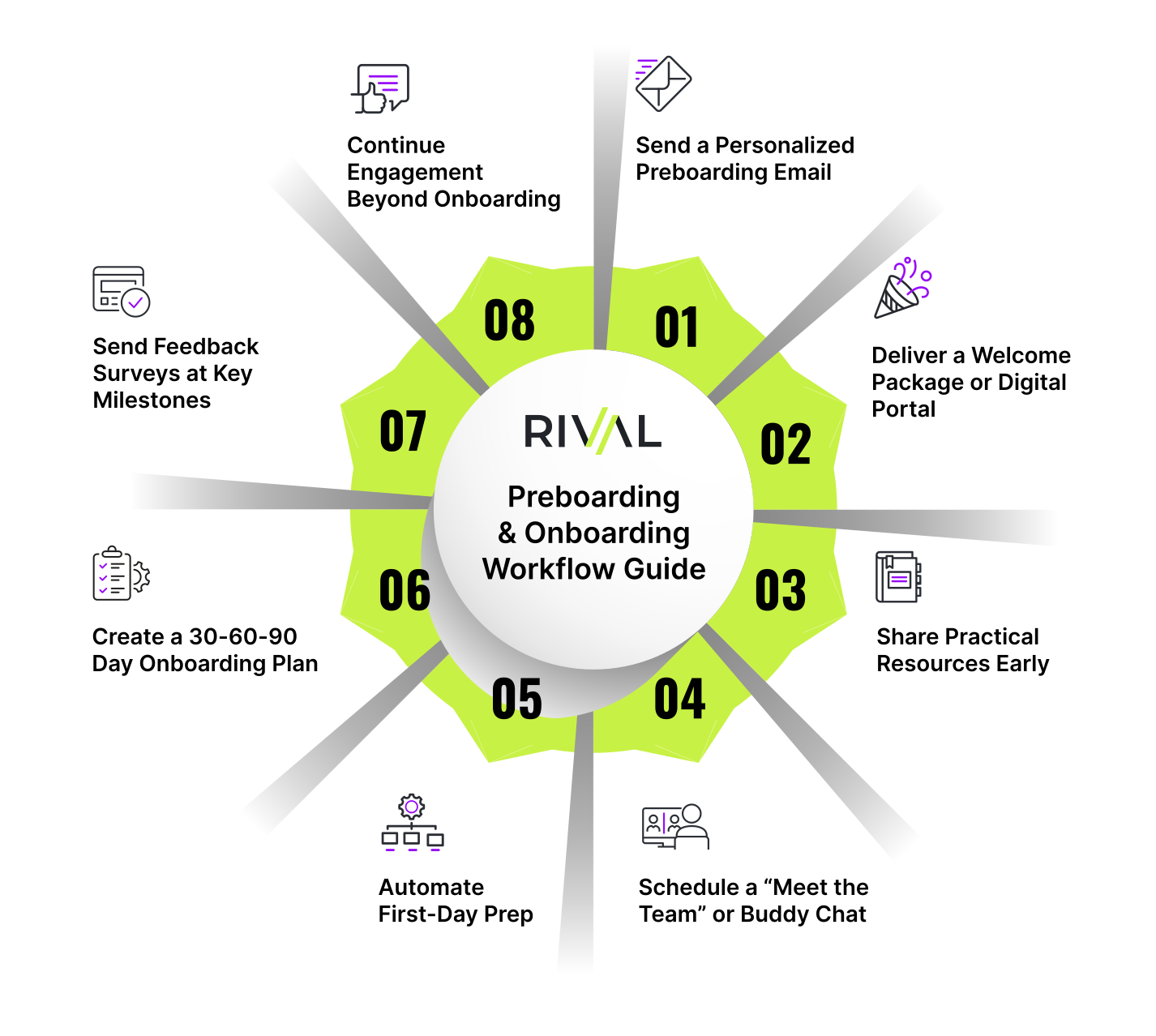
When preboarding and onboarding are designed as a single workflow, each step builds naturally on the last. Nothing gets dropped, nothing feels repetitive, and new hires don’t have to wonder what’s coming next. Below is a practical framework for creating that end-to-end experience, starting the moment an offer is accepted and continuing well beyond day one.
Step 1 – Send a Personalized Preboarding Email
Your preboarding process should begin with a clear, human message. Can you automate sending it? Sure! But it should still feel real and personalized. This is also the ideal moment to link to any early resources or portals, so new hires have one trusted place to go instead of chasing attachments across inboxes.
A strong preboarding email will:
Confirm the offer acceptance and next steps
Set expectations for what will happen before day one
Introduce key contacts (manager, HR, IT)
Reinforce excitement and belonging
Step 2 – Deliver a Welcome Package or Digital Portal
Preboarding works best when information is centralized. For remote or distributed teams especially, a digital portal creates early connection and reduces the “cold start” feeling many new hires experience. Whether it’s a physical welcome kit, a digital portal, or both, this step gives new hires a sense of orientation before they ever log in on day one. It’s where they start learning:
Who you are as an organization
How work actually gets done
What matters to your organization, from mission to values to rally cries
Step 3 – Share Practical Resources Early
Preboarding is the right time to handle the essentials that don’t require live interaction.
That often includes:
Policy acknowledgements and compliance documents
Tax and payroll information
Equipment and access requests
High-level benefits overviews
By shifting these tasks earlier, onboarding can focus less on paperwork and more on people, learning, and momentum.
Step 4 – Schedule a “Meet the Team” or Buddy Chat
Connection shouldn’t wait until the first team meeting. Assigning an onboarding buddy or scheduling an informal intro before day one gives new hires a familiar face and a low-pressure way to ask questions. It also reinforces that onboarding isn’t just an HR process—it’s a shared responsibility. This step is small, but it consistently has an outsized impact on confidence and engagement.
Step 5 – Automate First-Day Prep
Nothing undercuts a great first impression faster than missing logins or unprepared systems. Make sure your HR process automation is on point and fully aligned to the workflows that matter in your organization. The goal here is simple: when a new hire logs in for the first time, everything works.
Automating first-day prep ensures:
Equipment is ordered and delivered on time
Accounts and permissions are set up before day one
Managers and IT teams are aligned on responsibilities
Step 6 – Create a 30-60-90 Day Onboarding Plan
Onboarding doesn’t end after orientation. A structured 30-60-90 day plan helps translate early enthusiasm into clarity and progress. It gives managers a framework for coaching and gives new hires visibility into how success is measured.
Step 7 – Send Feedback Surveys at Key Milestones
Early feedback catches issues before they become attrition risks. When feedback is built into the workflow, it’s more likely to happen—and more likely to be acted on. Short pulse surveys at 30, 60, or 90 days will help HR and managers understand:
What’s working
Where expectations are unclear
Whether support systems are effective
Step 8 – Continue Engagement Beyond Onboarding
The employee journey doesn’t stop at “fully onboarded.” Ongoing check-ins, development conversations, recognition, and learning opportunities ensure the momentum created during onboarding carries forward into long-term engagement and retention.
How We Master Preboarding & Onboarding at Rival
When onboarding new employees at Rival, we think holistically about our preboarding and onboarding journeys. We design them as one continuous experience, supported by a single, automated journey in Rival Workflow. But whether you combine these two processes or not, the important thing is to consider both and how they work together.
Rival’s Preboarding Process
Preboarding at Rival begins the moment a candidate accepts their offer. Once the verbal offer is accepted, we launch a structured workflow that immediately guides both the new hire and internal teams through what happens next. The first task congratulates the new hire and includes:
A digital offer letter for electronic signature
Our Benefits Guide, so candidates can review benefits and perks alongside the offer
From there, tasks are automatically tailored in our Workflow platform, based on role, department, job level, location, and hire type. That personalization ensures compliance requirements, access needs, and communications are always appropriate.
Before day one, our preboarding activities include:
Required documents and acknowledgements (NDAs, policies, tax forms, direct deposit)
Credential and background-related documentation
IT provisioning triggers for equipment, system access, and credentials
Manager and HR notifications to coordinate timing and responsibilities
Early manager and CEO welcome messages
Assignment of an onboarding buddy
Scheduling of first-week meetings and recurring 1:1s
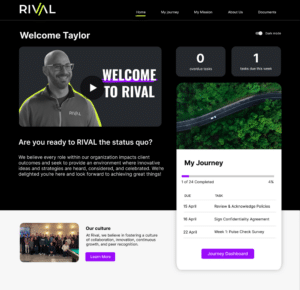
New hires also receive access to our customized New Employee Portal as soon as they accept the offer. This portal introduces Rival’s mission, values, leadership team, and ways of working, complete with videos, cultural context, and a message from our CEO. For a remote-first organization, this early visibility is critical to connection and confidence.
Rival’s Onboarding Process
Once a new hire’s start date arrives, onboarding continues seamlessly within the same workflow. At Rival, our onboarding tasks focus on activation, learning, and integration, including:
I-9 completion and verification (including remote workflows)
Payroll and HRIS integration
Benefits enrollment and platform access
Orientation sessions and introductions
Manager-led onboarding conversations
Role-specific systems, tools, and resources
Security, compliance, and training modules
We also layer in performance and feedback early. Managers set initial expectations tied to 30-60-90 day milestones, and new hires complete structured reflections and surveys to capture early signals. HR schedules regular check-ins to ensure support stays proactive rather than reactive.
Because everything runs through a single workflow, we maintain:
Clear ownership across HR, managers, IT, and leadership
Full audit trails for compliance
Consistent messaging and timing across teams
A predictable, repeatable experience for every new hire
The result? New employees ramp faster, feel connected sooner, and consistently tell us this was the best onboarding experience they’ve had.
Connect Every Step of the Employee Journey
Preboarding sets the tone. Onboarding sustains the momentum.
When both are designed together (and supported by automation), they stop feeling like administrative hurdles and start functioning as a true employee experience. Consistency replaces confusion. Momentum replaces delays. And HR teams spend less time chasing tasks and more time supporting people.
If you’re looking to connect every step of the new hire journey—from offer acceptance through long-term engagement—Rival Workflow makes it possible to design, automate, and scale the experience without adding complexity.
Explore how Rival Workflow supports seamless preboarding and onboarding from day zero onward.
Get the latest HR insights from Rival straight to your inbox
Sign up here!
Join 50,000 HR leaders who get our monthly newsletter.
 Nothing gets dropped, nothing feels repetitive, and new hires don’t have to wonder what’s coming next. Below is a practical framework for creating that end-to-end experience, starting the moment an offer is accepted and continuing well beyond day one.