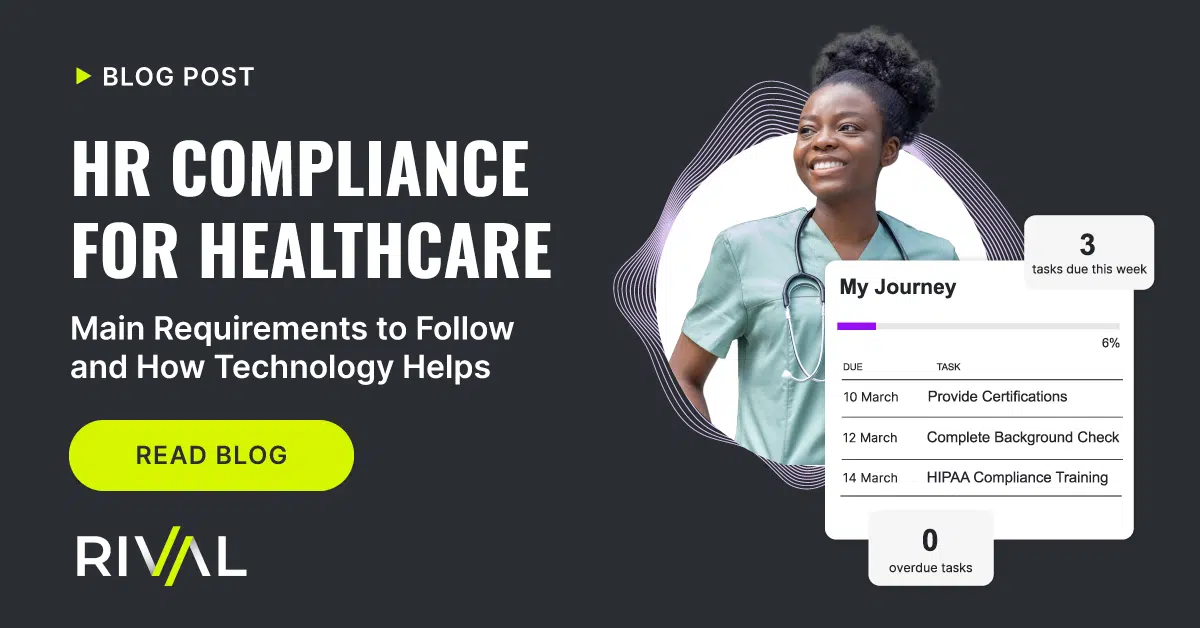
In healthcare, HR compliance isn’t paperwork. It’s patient protection. Which is why “we think we’re covered” can’t be a compliance strategy.
Every hiring decision, credential review, shift assignment, and termination happens in an environment where people, data, and patient care intersect—and where mistakes carry consequences way beyond fines. A missed license verification can sideline a unit. A privacy lapse can trigger investigations. An incomplete offboarding step can expose the organization months later.
That’s what makes HR compliance for healthcare fundamentally different from compliance in many other industries. It’s about protecting patients, employees, and the organization—all at once, all the time.
And yet, many healthcare HR teams are still trying to manage compliance through spreadsheets, shared folders, email reminders, and institutional memory. The result is predictable: compliance becomes exhausting, reactive, and fragile, especially as organizations grow, roles diversify, and regulations continue to evolve.
This is where HR workflow technology becomes absolutely essential.
The goal here isn’t to bury your HR teams under more systems or processes. It’s to create a compliance model that’s structured, repeatable, and embedded into everyday HR work, so compliance happens by design, not by some heroic effort. That’s the promise behind modern HR automation in healthcare: fewer manual handoffs, clearer accountability, and consistent execution across roles, locations, and employment types.
TL;DR
- Healthcare HR compliance is uniquely complex due to patient safety, data sensitivity, and regulatory oversight
- Manual compliance processes don’t scale and often fail silently
- Technology can embed compliance into workflows instead of layering on more work
- Platforms like Rival help healthcare HR teams operationalize compliance across the employee lifecycle
Why Healthcare HR Compliance Requires a Different Approach
Healthcare HR teams operate under overlapping federal, state, and local requirements, often simultaneously. Regulations don’t just govern employment practices; they shape who can work, when they can work, and under what conditions. Credentials must be current, background checks must be complete, access to systems and facilities must be tightly controlled—and all of it must be documented.
The challenge isn’t understanding that these requirements exist. It’s enforcing them consistently across a workforce that includes full-time employees, part-time staff, contractors, traveling clinicians, and temporary workers—often spread across multiple locations and jurisdictions.
When compliance depends on manual tracking, it breaks down at the edges: during rapid hiring spikes, mergers, cross-facility or department transfers, or offboarding. That’s why healthcare organizations are increasingly turning to automating compliance, not to cut corners, but to reduce risk.
With the right technology…
- Compliance steps can be built directly into HR workflows.
- Credential checks happen automatically before onboarding progresses.
- Role- and location-specific requirements are applied without guesswork.
- Documentation is captured as work happens, creating audit-ready records without extra effort.
This is the foundation for sustainable healthcare HR compliance. And it sets the stage for understanding the specific regulations HR teams must manage, and how technology can help enforce them without slowing the organization down.
Compliance Requirements for Healthcare HR
Healthcare HR teams operate at the intersection of employment law, patient safety, and data protection. That means compliance isn’t governed by a single framework, but by a set of overlapping requirements that touch nearly every stage of the employee lifecycle.
Understanding these requirements—and where they show up in everyday HR work—is the first step toward managing them sustainably.
 OSHA Safety Standards
 OSHA Safety Standards
The Occupational Safety and Health Administration (OSHA) sets standards to protect workers from hazards, including exposure to bloodborne pathogens, workplace violence, and unsafe conditions. In healthcare environments, these standards directly affect onboarding, training, incident reporting, and ongoing certification.
For HR, this often means tracking required training, documenting policy acknowledgments, and ensuring employees are properly cleared for specific work environments. When these steps are handled manually, gaps are easy to miss, especially during periods of rapid hiring or role changes.
HIPAA Patient Privacy
 HIPAA Patient Privacy
HIPAA compliance extends beyond clinical staff. Any employee who may access patient information, directly or indirectly, must be trained, authorized, and monitored appropriately.
From an HR perspective, HIPAA affects onboarding workflows, role-based access, policy acknowledgments, and offboarding procedures. It also requires clear documentation showing that employees were trained and granted access in accordance with their responsibilities. Without structured workflows, these requirements are difficult to enforce consistently.
Background Checks
 Background Checks
Background checks are a foundational requirement in healthcare hiring, particularly for roles involving patient contact or sensitive data. HR teams must ensure checks are completed, reviewed, and documented before employment begins—and that standards are applied consistently across roles and locations.
Manual tracking introduces risk here, especially when hiring volume spikes or requirements vary by state or role.
Credentials and Identity Verification
 Credentials and Identity Verification
Licenses, certifications, and identity verification are non-negotiable in healthcare. HR teams are responsible not only for collecting these credentials, but for confirming their validity and tracking expiration dates over time.
This is one of the most operationally demanding areas of healthcare HR compliance, and one of the most difficult to manage without automation.
Union and State-Specific Rules
 Union and State-Specific Rules
Many healthcare organizations operate across multiple jurisdictions and under collective bargaining agreements. That means compliance requirements can change based on location, job classification, or employment status.
HR teams need systems that can adapt workflows dynamically, applying the right rules to the right employees without relying on manual interpretation.
How Dedicated Technology Makes Healthcare HR Teams Compliant
Managing these requirements manually slows HR teams down and increases exposure. Dedicated HR technology helps by embedding compliance into workflows instead of treating it as a separate task.
Automating Credentialing and Pre-Boarding
 Automating Credentialing and Pre-Boarding
Automated pre-boarding workflows ensure that background checks, license verification, and required documentation are completed before an employee can move forward. Instead of relying on checklists or reminders, the system enforces sequence and completion automatically.
With Rival Workflow, these steps become part of a controlled journey that prevents progress until requirements are met, and includes processes that support I-9 documentation, integrated e-Verify, and integrations with background check providers.
Adapting Workflows by Role and Location
 Adapting Workflows by Role and Location
Healthcare roles aren’t interchangeable, and neither are their compliance requirements. Technology allows HR teams to configure workflows based on role, location, or employment type, ensuring the right forms, checks, and approvals are triggered every time.
This reduces guesswork and eliminates the need for one-off exceptions.
Supporting Complex Employment Models
 Supporting Complex Employment Models
Traveling nurses, contractors, and temporary clinicians introduce additional compliance complexity. Dynamic workflows make it possible to apply different rules and timelines while still maintaining centralized visibility and control.
Ensuring Data Accuracy and Compliance Reporting
 Ensuring Data Accuracy and Compliance Reporting
Accurate data is the backbone of compliance. Automated workflows reduce manual entry, enforce required fields, and generate consistent records. Reporting becomes a byproduct of execution rather than an after-the-fact scramble.
Built-In Audit Trails and Guardrails
 Built-In Audit Trails and Guardrails
Every step completed, approved, or delayed is automatically recorded. These audit trails make it easier to demonstrate compliance during inspections and internal reviews without additional administrative work. With fines reaching thousands of dollars per violation, maintaining accurate, complete, and auditable documentation is not optional — it is a critical risk mitigation practice.
Customizing Offboarding for Compliance
 Customizing Offboarding for Compliance
Offboarding is one of the most common points of compliance failure. Automated workflows ensure access is revoked, documentation is completed, and state-specific or contractual requirements are respected for each employee’s exit.
Learn more about how workflow automation supports compliance beyond onboarding.
Best Practices to Simplify HR Compliance in Healthcare
Technology is most effective when paired with clear operational practices.
Leading healthcare organizations, such as the Cleveland Clinic, focus on creating a single source of truth by connecting HRIS, ATS, and workflow systems. They design processes that assume change—like new roles, new locations, new regulations—and build flexibility into their workflows from the start.
They also treat offboarding with the same rigor as onboarding, recognizing that compliance risk doesn’t end when employment does. And they centralize audit data so compliance readiness is continuous, not reactive.
Most importantly, they implement dynamic HR workflows that adapt automatically, reducing reliance on memory, spreadsheets, and workarounds.
Read how Cleveland Clinic implemented Rival Workflow to streamline onboarding.
Scale HR Healthcare Compliance With Rival
Healthcare HR compliance doesn’t get easier with more reminders. It gets easier when the right steps are built into the work, so nothing important depends on memory, manual follow-up, or luck.