

The calendar flips to June and suddenly it’s all hands on deck. Managers scramble to remember what their direct reports actually accomplished in January. Feedback arrives late, thin, or copied verbatim from the last cycle. HR teams spend days chasing submissions, editing vague praise, and wondering how a process that’s supposed to drive performance has become the thing everyone dreads.
In mid-sized to large organizations, the compounding effect of weak manager writing, inconsistent calibration, and poor communication turns mid-year reviews into a multi-week organizational tax with diminishing returns.
Sound familiar? Then keep reading.
What This Blog Post Covers
- Why mid-year reviews are more valuable than most teams treat them
- 5 actions HR can take right now, before the cycle opens
- Where manager review quality breaks down and why
- How AI tools like ROSI are changing the review writing process
- Calibration best practices and what to do after the cycle closes
Whether your mid-year review cycle opens in June or July, the preparation window is now.
Why Mid-year Reviews Matter More Than Most People Think
Mid-year reviews are frequently treated as a compliance checkbox and merely something to get through before summer. That framing is a massive missed opportunity. According to research from Gallup, employees who receive regular feedback are 3.6x more likely to be engaged at work. Therefore, mid-year is one of the most consequential touchpoints in their entire employment experience. It signals whether leadership sees them, whether their effort is being tracked, and whether there’s a path forward. For organizations, it’s a rare, structured moment to course-correct before the year ends and the stakes get higher.

Retention Inflection Point
Employees who receive meaningful, specific mid-year feedback are significantly more likely to remain engaged and stay through year-end. Conversely, those who receive generic or no feedback often begin quietly disengaging (or “quiet quitting”) by Q3, and leave before December. The mid-year review is one of the highest-leverage retention interventions HR has at its disposal.
Performance Course-Correction
Unlike year-end reviews, mid-year conversations still leave time to act. A well-structured mid-year review can reset expectations, redirect energy, close skill gaps, and prevent a year-end surprise for both manager and employee. Without it, underperformance festers and high performers drift without direction.
HR’s Strategic Role
HR’s job isn’t just to administer the logistics of a review cycle. It’s to ensure that reviews are actually impactful and that the feedback is specific, fair, and actionable. When HR treats mid-year as a forms-and-deadlines exercise, quality suffers across the board. When HR treats it as a strategic intervention, the whole organization benefits.
Mid-year reviews aren’t a formality. They’re a performance and retention inflection point—and HR controls the conditions that determine whether they’re meaningful or meaningless.
Start Now: 5 Things HR Can Do Before the Mid-Year Review Cycle Opens
The biggest mistake HR teams make is treating review prep as something that starts when the system opens. In reality, the work that determines review quality happens in the weeks before. May and early June are your preparation window, so use them intentionally. One of the most underutilized practices is simply taking time now to reflect on what’s already happened this year: logging notable performance moments, capturing goal progress, and building the source material that will make reviews far easier to write when the cycle opens.
1. Audit Your Review Templates
Pull up your current review prompts and ask a hard question: are they actually driving useful, specific responses, or are they so generic that any answer fits? Prompts like “Describe performance this period” invite vague prose. Better prompts ask managers to cite examples, assess impact against goals, and identify specific development opportunities. If your templates haven’t been updated recently, now is the time.
2. Set Manager Expectations Early
Calibrate what “good” feedback looks like before the cycle opens, not after you’ve received weak submissions. Share examples of strong reviews (anonymized). Clarify what HR considers too vague. The goal is to raise the floor on quality before writing begins, not to spend three weeks editing after the fact.
3. Pull Performance Data Now
Don’t wait for managers to reconstruct the first half of the year from memory. Pull goal progress reports, engagement survey signals, and relevant attendance or output data now. Package it accessibly so managers walk into the review cycle with context, not a blank page.
4. Communicate the Timeline Clearly
Employees and managers hate surprises. Publish the full review timeline—self-assessment window, manager review deadline, calibration sessions, conversation requirements—well in advance. Include clear instructions on what’s expected at each stage. HR should never be the bottleneck because people didn’t know what was coming.
5. Train Managers on Bias
Recency bias, leniency bias, and the halo effect reliably show up during mid-year. A brief, targeted training session or manager toolkit—not a two-hour compliance module—can meaningfully reduce their impact. Focus on recognition, not shame: most managers aren’t aware their patterns are affecting review quality.
Where Review Quality Breaks Down at Scale
Ask any HR leader what the most frustrating part of a review cycle is, and most will give you some version of the same answer: chasing managers, editing vague submissions, and wondering why thoughtful feedback is so hard to get at scale. The answer isn’t that managers don’t care. It’s that most managers are not writers, and the review process asks them to produce clear, structured, developmental prose about multiple people under deadline pressure, with no real guidance or tooling to support them. This is a huge risk when you consider that managers account for at least 70% of the variance in team engagement (Gallup).
The Most Common Review Writing Failures
Vague Praise Without Substance
“John is a great team player and always brings positive energy.” This tells the employee nothing and HR even less. It cannot be used in calibration, succession planning, or compensation decisions.
No Development Direction
According to Gallup, only ~28% of employees say their manager involves them in goal setting. Reviews that describe what happened without pointing toward what should change or grow next leave employees with no clearer sense of their path forward than when they arrived.
Copy-Paste From Last Cycle
The dates change, but the text doesn’t. This signals to the employee that no one is actually tracking their progress, and signals to HR that the process is broken.
The Cost to HR
When manager writing quality is low across the board, HR absorbs the cost. The team spends hours chasing late submissions, following up on incomplete reviews, coaching managers on what to add, and attempting to calibrate across ratings that aren’t backed by evidence.
At scale—50 managers, 300 employees—this becomes an unsustainable operational burden. And the downstream effects are real: calibration conversations lack substance, high performers feel undervalued, and the review process loses credibility with employees over time.
Low-quality manager writing is where the mid-year review process fails most organizations—and where HR loses the most time and credibility.
Review Writing with ROSI: Fixing Both Sides of the Equation
Most review processes have a fundamental sequencing problem. Managers are expected to write thoughtful, specific assessments, but the self-assessments that should inform those reviews arrive late, thin, or both. The result is a manager staring at a blank text box trying to reconstruct six months of performance from memory, then writing something vague and hoping no one notices. ROSI’s Review Writer addresses both sides of this problem simultaneously.
For Employees: Self-Assessments That Actually Reflect Impact
ROSI helps employees articulate what they’ve accomplished. This shifts self-reviews from listing tasks to framing outcomes in terms of business impact. The self-assessment stops being the thing everyone writes in 20 minutes the night before it’s due. Instead, employees produce structured, specific narratives that give their manager real signal to work with. The quality difference is immediate and significant.
For Managers: Better Input, Better Output
When managers receive high-quality self-assessments, they’re no longer starting from nothing. ROSI then helps them write structured reviews that reflect the actual review period, not just the last six weeks distorted by recency bias. The result is feedback that’s specific, fair, and developmentally useful. Managers spend less time staring at a blank screen and more time writing something that matters.
For HR: Signal Instead of Noise
The flywheel effect is where ROSI delivers the most value to HR leaders. Stronger self-assessments produce more useful manager reviews. More useful manager reviews mean HR enters calibration with real, comparable data—not a collection of vague narratives that can’t be ranked or discussed meaningfully. The result is fewer submissions to chase, more consistency across teams and levels, and calibration conversations that actually move the needle.
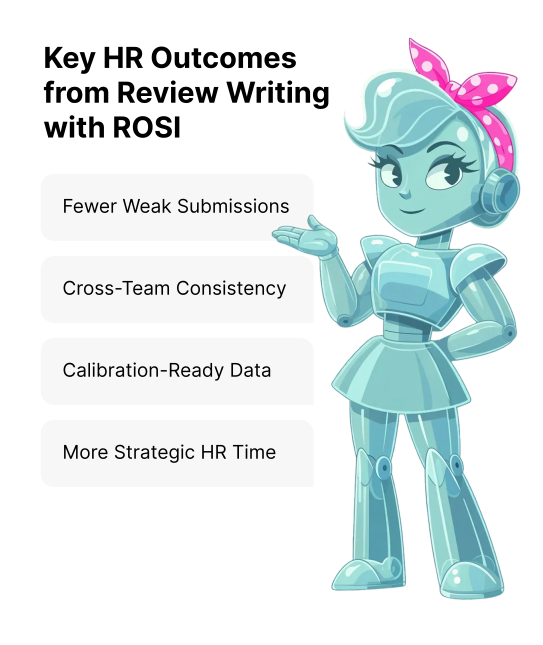
Key HR Outcomes from Review Writing with ROSI
- Fewer Weak Submissions: Less time chasing and editing manager reviews that don’t meet the quality bar

- Cross-Team Consistency: Comparable review quality across departments, levels, and writing styles
- Calibration-Ready Data: Enter calibration with usable signal, not noise that requires interpretation
- More Strategic HR Time: Less time policing the process, more time using the output to drive decisions
The ROSI Flywheel: How Better Reviews Compound
The improvement isn’t linear; it’s a flywheel. Each element of the ROSI-assisted review process strengthens the next, creating a cycle where quality compounds rather than degrades under deadline pressure.
- Employees write stronger self-assessments and frame impact, not just tasks
- Managers receive better input and write specific, structured reviews
- HR enters calibration with real signal and comparable, evidence-backed data
- Calibration drives better decisions on performance, development, comp—all feeding into the next cycle
When HR breaks this flywheel—by accepting weak self-assessments, allowing vague manager reviews, or skipping calibration structure—the entire downstream process degrades. The goal of review infrastructure, and tools like ROSI, is to make the high-quality path the path of least resistance for everyone involved.
Running Calibration That Actually Means Something
Calibration—a process where managers and HR meet to compare, review, and standardize employee performance ratings, ensuring consistency, fairness, and objectivity across different teams—is where the value of a review cycle either gets realized or lost. Too often, calibration sessions become either rubber-stamp exercises—where every manager’s ratings are accepted without scrutiny—or contentious debates where the loudest voice wins. Neither serves the organization, and both undermine the trust of employees who submitted honest self-assessments and expected fairness in return.
What Good Calibration Looks Like
- Anchor on evidence, not impressions. Every rating discussion should be traceable to specific examples from the review text. “I just feel like Sarah is a top performer” is not calibration evidence; it’s a gut check.
- Watch for systematic outliers. If one manager’s entire team rates in the top tier and another’s rates in the middle, that’s a calibration signal worth examining. It may reflect real performance distribution, or it may reflect rating inflation or deflation.
- Document decisions as you go. Calibration decisions that aren’t documented disappear. When an employee asks why they received a particular rating, HR needs to be able to point to the calibration record.
- Protect against affinity bias. Calibration rooms are where affinity bias—favoring employees who are similar to the calibrators—shows up most acutely. Diverse calibration panels and structured discussion formats both prevent bias.
How ROSI Changes the Calibration Dynamic
When HR enters a calibration session with reviews that have been written with ROSI’s assistance, the quality floor is significantly higher. Managers have written in a structured format. Self-assessments have provided comparable input. The result is that calibrators are working from actual evidence rather than trying to interpret what a manager meant by “consistently exceeds expectations.”
This shifts the calibration conversation from remediation—trying to figure out what someone actually meant—to decision-making: understanding real performance distribution, identifying high-potential employees, and making defensible decisions about ratings and development investments.
Better review inputs don’t just save time in calibration. They produce more equitable outcomes because decisions are grounded in evidence rather than impression.
After the Cycle Closes: Don't Let the Data Go to Waste
The mid-year review cycle generates a significant volume of organizational intelligence, and most companies leave almost all of it on the table. Once the deadline passes and conversations are logged, the data gets filed away until year-end. This is one of the most consequential missed opportunities in the people analytics space. The mid-year snapshot, if analyzed and acted on, is one of the clearest pictures of organizational health available to leadership.
Capture What Worked—and What Didn’t
Before institutional memory fades, document the process itself: Which templates produced the strongest feedback? Where did managers struggle most? What deadline structure worked? Which teams submitted on time and which needed repeated follow-up? This retrospective is your blueprint for a stronger year-end cycle and should be captured within two weeks of cycle close.
Share Aggregate Insights With Leadership
HR is sitting on a snapshot of organizational health. Aggregate the data: What percentage of employees received a development-focused review? Where are performance concerns concentrated? Which teams show strong engagement signals? This is strategic intelligence that belongs in front of senior leadership—packaged as a brief, actionable report, not buried in an HRIS.
Feed the Data Into L&D and Succession Planning
Mid-year reviews are a gold mine for learning and development planning. Skills gaps identified across multiple reviews signal curriculum investment priorities. High performers flagged in calibration should be surfaced in succession conversations. Development themes that appear across a team suggest a manager coaching opportunity. None of this happens automatically—HR has to build the bridge.
Inform Comp and Rewards Decisions
Where mid-year performance data is used to inform compensation decisions—merit increases, spot bonuses, or equity refresh windows—the quality of the review documentation directly affects the fairness and defensibility of those decisions. Strong review data creates a paper trail that protects the organization and builds employee trust in the pay process.
Mid-year Reviews Are a Window Into Your People Strategy. Make Them Count.
The organizations that treat mid-year reviews as a strategic event—not an administrative obligation—are the ones that retain their best people, catch performance problems before they compound, and walk into year-end with real data instead of guesswork. The gap between a mediocre review cycle and an excellent one isn’t talent or intention. It’s preparation, tooling, and process discipline.
- Start Before the Cycle Opens: Audit templates, set manager expectations, pull performance data, and communicate timelines now (in May). The prep window is your highest leverage moment.
- Raise the Quality Floor: Use ROSI Review Writer to help employees articulate impact and help managers write reviews that reflect the actual review period—not just recency bias and generic praise.
- Run Calibration With Evidence: Enter calibration with usable, comparable data. Anchor on examples. Document decisions. Protect against bias. Make the process defensible and fair.
- Use the Output Strategically: Don’t file the data. Feed it into L&D planning, succession conversations, leadership reporting, and comp decisions. Mid-year is a snapshot of org health—treat it that way.
The review cycle you run this June will shape how your people feel about this organization in December. Build the process that earns their trust.