
What is next for hiring in 2026? Ask most talent acquisition leaders, and you will hear a version of the same answer: applicant volume is up but quality is not, AI is helping and complicating things at the same time, and recruiters are being asked to hire with far more precision than before.
Recent reporting from SHRM, HR Dive, LinkedIn, and Korn Ferry all points in the same direction: TA is getting more strategic, more AI-enabled, and more accountable for quality, not just speed.
That means, like last year, AI is reshaping sourcing and screening. Skills still matter more than pedigree. Internal mobility is still a key piece of a successful talent acquisition strategy. But the mood in 2026 is a little different. The conversation has shifted from “how do we automate more?” to “how do we automate without losing trust, flooding the funnel with junk, or decreasing candidate quality?”
In other words, this is no longer just about hiring faster. It is about doing it with better information, more judgment, and a lot less noise.
In this post, we will look at…
- the current state of talent acquisition in 2026
- the biggest talent acquisition trends shaping the year
- the hiring trends getting the most attention
- and the technology stack helping teams adapt.
The Current State of Talent Acquisition in 2026
Talent acquisition in 2026 looks busier on the surface, but underneath, it’s a little more limited. There’s a lot of noise, but not a lot of there there.
Hiring teams are still lean. SHRM has framed 2026 as an era of “precision over scale,” where lean teams and AI are changing the hiring math and pushing employers to hire only what they truly need.
HR Dive makes a similar point: hiring may be more employer-friendly than it was a few years ago, but recruiters are still dealing with more applicants, more caution from candidates, and more pressure to be highly selective. But more applicants does not automatically mean easier hiring. In fact, it can mean the opposite.
AI has made it easier for candidates to tailor résumés to job descriptions, mass-produce application materials, and in some cases misrepresent identity or qualifications. In Checkr’s 2025 survey of 3,000 managers involved in hiring, 59% said they had suspected a candidate of using AI to misrepresent themselves, 62% said job seekers were better at faking identities with AI than hiring teams were at detecting them, and only 19% said they were extremely confident their current hiring process would catch a fraudulent applicant.
That creates a strange problem where recruiters have more inbound activity, but not necessarily more trustworthy signals to guide hiring well.
At the same time, candidates are not thrilled by fully automated experiences either. HireVue’s 2025 candidate experience research found that job seekers see the upside of AI, but still want fairness, transparency, and a human touch. And Phenom’s 2025 State of Candidate Experience Report suggests most employers still do a poor job using AI and automation to personalize career sites and job discovery.
So the 2026 TA environment is not just “AI everywhere.” It is more specific than that. AI is raising expectations, increasing scale, and forcing a higher bar for verification and candidate experience at the same time.
Top Talent Acquisition Trends in 2026
1. AI recruiting grows up
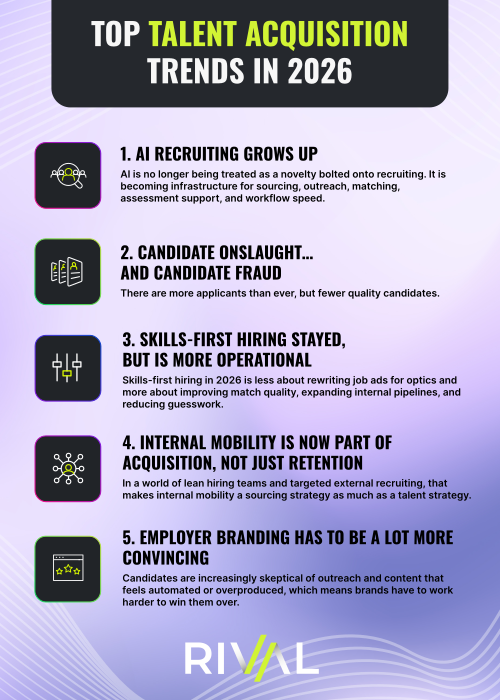
In 2025, the question was whether TA teams were adopting AI. In 2026, the better question is whether they are using it well.
LinkedIn reports that companies whose recruiters use AI-Assisted Messaging the most are 9% more likely to make a quality hire, and that companies with the most skills-based searches are 12% more likely to make a quality hire. Korn Ferry likewise reports that 84% of talent leaders worldwide say they will use AI in 2026.
The real shift is that AI is no longer being treated as a novelty bolted onto recruiting. It is becoming infrastructure for sourcing, outreach, matching, assessment support, and workflow speed. (Which is a pretty important factor in keeping all those shiny new recruits.)
What to do: AI is increasing capacity, but not always outcomes. Leverage it for sourcing, personalized outreach, skills matching, and recruiter workflows. This is the sweet spot for Rival Recruit and maximizing recruitment impact with AI.
2. Candidate onslaught…and candidate fraud
This one was not a major headline a year ago. In 2026, it absolutely is. There are more applicants than ever, but fewer quality candidates.
With so many resumes flooding the market, hiring decisions are getting much harder. People are applying for jobs they aren’t qualified for. AI is making application ‘slop’ a real problem to deal with as recruiters review more and more résumés and come back with fewer and fewer real matches.
This is made exponentially worse by the fact that not all of those candidates are even real. Fake résumés, AI-polished misrepresentation, identity deception, and interview impersonation are putting more pressure on recruiters to validate what they are seeing. Checkr’s data is pretty blunt here: 31% of managers said they had interviewed a candidate that later revealed to be using a fake identity, and 35% said someone other than the listed applicant had participated in a virtual interview.
That does not mean recruiters need to become data scientists or private investigators. It does mean the old assumptions about résumés, portfolios, and polished answers are less reliable than they used to be.
What to do: Tighten screening and verification steps, especially for remote workflows. Rival already has a useful angle here with its content on fake resumes.
3. Skills-first hiring stayed, but is more operational
Skills-based hiring is not new anymore. What is changing is how organizations use it.
LinkedIn’s 2025 recruiting research ties skills-based search directly to better quality-of-hire outcomes, and its 2026 talent report ties skills data to internal mobility and career growth. That matters because skills-first hiring in 2026 is less about rewriting job ads for optics and more about improving match quality, expanding internal pipelines, and reducing guesswork.
What to do: Move beyond “remove degree requirements” as the whole strategy. Build better skill signals into search, screening, interview design, and internal opportunity matching.
4. Internal mobility is now part of acquisition, not just retention
This trend was already underway, but it is getting harder to ignore.
LinkedIn’s 2026 talent report argues that skills data empowers internal mobility by helping talent move fluidly across the organization, and that growth needs to be driven by capability, not hierarchy. In a world of lean hiring teams and targeted external recruiting, that makes internal mobility a sourcing strategy as much as a talent strategy.
What to do: Treat internal candidates like a real talent pool. If your team is only looking outside first, it is probably missing speed, context, and retention upside.
5. Employer branding has to be a lot more convincing
Employer branding still matters, but generic brand language is not doing much heavy lifting anymore.
The reality is, people are thinking twice before they take a leap in an uncertain job market and a volatile era of role change. Job hugging, a workplace trend where employees stay put—even if they are unsatisfied, under-challenged, or outright bored—has become a real trend as people grapple with fear of economic uncertainty or a lack of better opportunities.
At the same time, candidates are increasingly skeptical of outreach and content that feels automated or overproduced. They know their value and want to see the money in career opportunities. Which means brands have to work harder to win them over.
What to do: Be clearer, not shinier. Role-specific stories, pay transparency, benefits and flexibility, career progression mapping, manager visibility, realistic previews, and actual signals of growth will do more than another polished careers-page paragraph about values.
Top Hiring Trends in 2026
1. Hiring is more focused and more selective
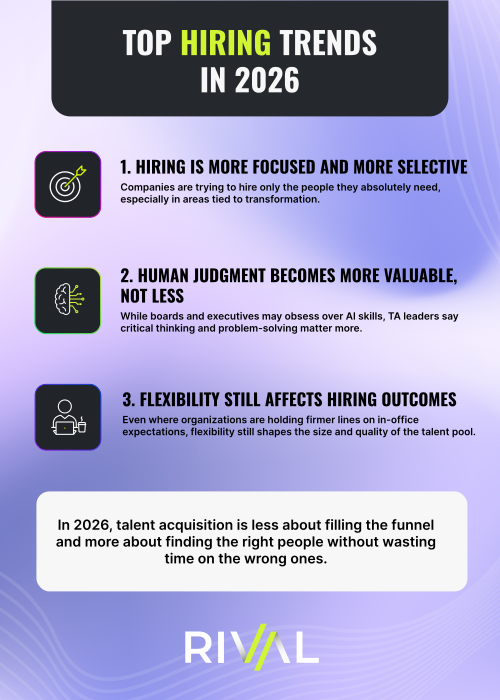
HR Dive’s reporting on 2026 hiring is pretty clear: companies are trying to hire only the people they absolutely need, especially in areas tied to transformation. That means recruiters are under more pressure to justify fit, speed, and long-term value.
This is not a spray-and-pray market. It is a quality and precision market.
2. Human judgment becomes more valuable, not less
Korn Ferry’s 2026 trends report makes a smart distinction here: while boards and executives may obsess over AI skills, TA leaders say critical thinking and problem-solving matter more. Their survey found that 73% of TA leaders rank critical thinking as their top recruiting priority, while AI skills rank lower. Deloitte’s 2026 Human Capital Trends report lands in a similar place, arguing that competitive advantage is now less about technology differentiation and more about human adaptivity, creativity, and judgment.
That is a useful correction to some of the noisier AI discourse. Companies do need people who can work with AI. They also need people who can question it, interpret it, and know when not to trust it.
3. Flexibility still affects hiring outcomes
Remote-versus-office policy has not stopped being a recruiting issue just because some employers want it to.
Korn Ferry reports that 52% of TA leaders say office mandates hinder recruitment, while 72% say remote roles are easier to fill. Even where organizations are holding firmer lines on in-office expectations, flexibility still shapes the size and quality of the talent pool.
What to do: If flexibility is limited, the rest of the candidate value proposition has to work harder. Skilled candidates know their value and still expect flexible work (and 4 in 5 employers are having trouble finding skilled workers). So if flexibility isn’t something you can offer, premium salaries or other benefits are going to be required to attract those candidates in other ways.
Technology for the Future of Talent Acquisition
If 2026 has a theme, it is this: the winning TA stack is not the one with the most automation. It is the one that creates more signals, better matching, and less manual chaos.
That means tools for:
- AI-powered sourcing and outreach, so recruiters can find and engage talent earlier
- Skills-based matching, so screening is based on capability instead of flashy résumés
- ATS integrations, so data does not get stranded between systems
- Candidate verification and better screening discipline, so high-volume funnels do not become high-risk funnels
- Cleaner recruiter workflows, so teams can move fast without making the experience feel robotic
- Cleaner workflows for onboarding and ongoing employee experience, because it’s a lot easier to keep an employee than find a new one!
This is where Rival Recruit fits especially well. It gives TA teams a way to use AI more practically—for sourcing, matching, workflow efficiency, and better decision support—without losing sight of the fact that recruiting still depends on trust, context, and human judgment. For more on that shift, Rival’s resources on AI in talent acquisition and recruitment with AI are natural next steps.
What Does the Future of Talent Acquisition Look Like?
In 2026, talent acquisition is less about filling the funnel and more about finding the right people without wasting time on the wrong ones.
The strongest teams are not just automating more. They are also filtering better, verifying more carefully, hiring more selectively, treating skills and internal mobility as real strategic levers, and using AI where it adds signals instead of noise.
The takeaway is not “replace recruiters with AI.” It is almost the opposite.
The future of talent acquisition belongs to teams that can combine better technology with better judgment, and build hiring processes that are faster, smarter, and a lot harder to fool.