No HR team ever sets out to build document chaos. It just…happens.
An onboarding packet here. A compliance form emailed there. A signed PDF saved to someone’s desktop “for now.” Before long, critical employee documents are scattered across inboxes, shared drives, legacy systems, and vendor portals, with no clear ownership, no real-time visibility, and no easy way to prove what happened when it matters most.
The issue isn’t the number of documents HR manages, it’s the lack of a system that governs how those documents move. When forms aren’t connected to a workflow, they rely on human memory and manual coordination to progress. That’s when delays creep in, deadlines get missed, and risk quietly increases.
HR document management automation solves this by shifting the focus from storing documents to orchestrating them. Instead of asking HR to push paperwork forward by hand, automated workflows ensure the right documents appear at the right moment, move to the right people, and close the loop without constant intervention.
TL;DR
- HR document problems are workflow problems, not filing problems
- Automation connects documents to real HR journeys (onboarding, changes, offboarding)
- The right platform reduces compliance risk, manual work, and employee friction
- Rival Workflow helps HR teams automate document-driven journeys without complex configuration
Why HR Document Management Breaks Down
Most HR teams already have places to store documents. What they don’t have is a system that governs how documents move from one place to another.
As a result, common moments in the employee lifecycle become unnecessarily fragile. New hires wait longer than they should because paperwork gets stuck in review. HR teams spend hours chasing signatures and clarifying which version of a form is the “final” one. During audits, compliance teams are forced to reconstruct timelines after the fact instead of relying on a clear, system-generated record.
These problems compound as organizations scale. Each additional location, job family, or regulatory requirement adds complexity. Without automation, complexity always becomes manual work.
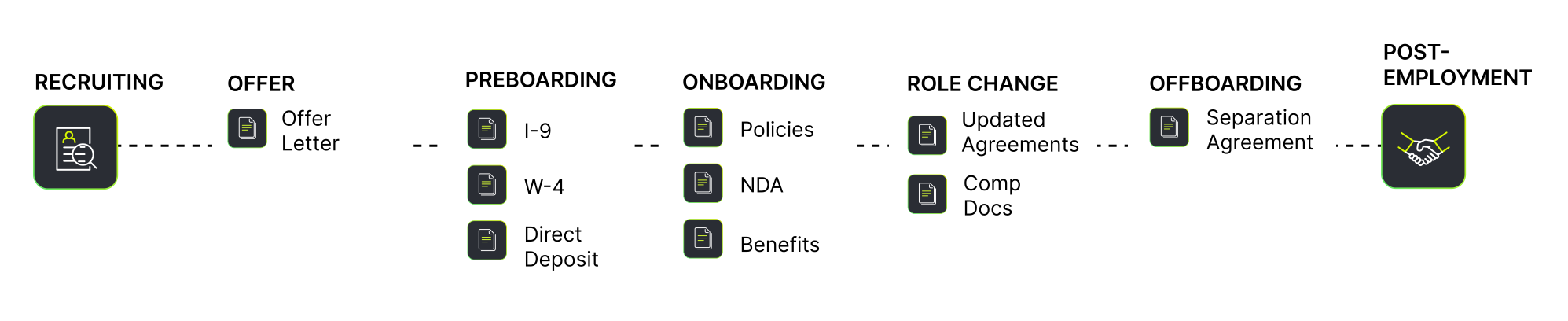
A modern HR document management workflow addresses this by treating documents as active steps in a process rather than static files. Documents are triggered automatically based on role, location, or event. Completion is tracked in real time. Approvals follow predefined paths. And every action is recorded as part of a defensible audit trail.
That shift changes how HR operates day to day. Instead of managing exceptions, teams manage by design.
Learn how Rival Workflow supports automated employee journeys from start to finish.
How Rival Helps HR Teams Streamline Document Management
Rival approaches document management as part of a connected HR operating model, not a standalone repository. Documents live inside workflows that mirror how employees actually move through the organization, from onboarding, role changes, compliance events, and offboarding.
When documents are embedded this way, several things happen at once. Employees receive requests when they’re most relevant, rather than as disconnected tasks. Managers and HR gain clear visibility into what’s complete, what’s pending, and where bottlenecks exist. And compliance becomes a natural outcome of the process, not an extra layer of oversight.
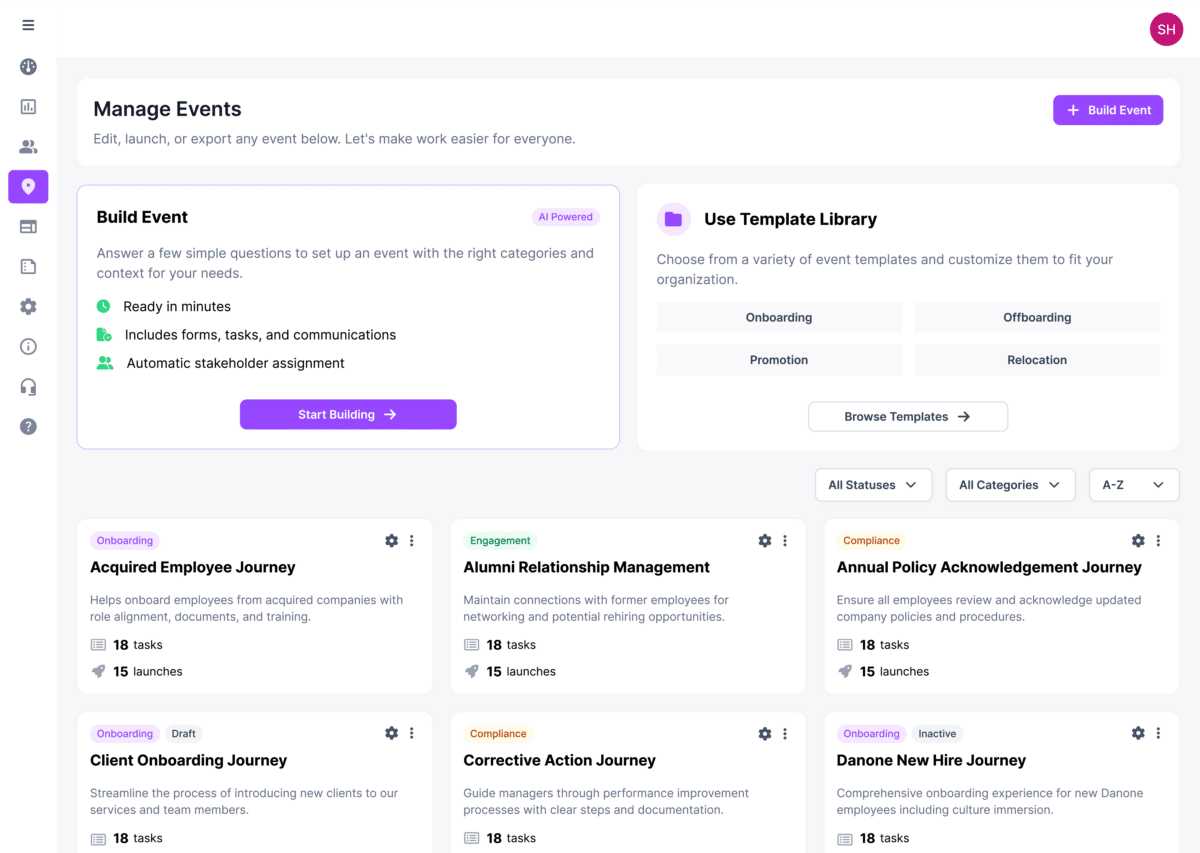
Just as importantly, Rival’s workflows are configurable without heavy technical effort. HR teams can tailor document journeys by role, location, or policy using no-code tools, making it easier to adapt as regulations change or the business evolves. That flexibility prevents the system from becoming brittle over time.
An Automated Workflow for HR Document Management
Once documents are treated as part of a workflow instead of standalone files, the process becomes both simpler and more resilient. The goal isn’t to automate for automation’s sake, but to design a system that consistently moves work forward with minimal friction and maximum visibility.

It starts with understanding how documents already flow, or fail to.
Most HR teams have a general sense of their document processes, but automation works best when those steps are made explicit. Mapping where documents originate, who needs to act on them, and what happens next reveals where delays, rework, and risk tend to surface. In Rival, this mapping becomes the foundation for a configurable journey rather than a static diagram.

From there, the workflow platform matters.
An effective HR document management workflow requires more than storage or routing rules. It needs to connect documents to real employee events such as onboarding, job changes, compliance checkpoints, and exits, and adjust automatically based on role, location, or policy. Rival’s workflow engine was built specifically for these kinds of HR journeys, allowing teams to automate document-driven processes without relying on custom code or external consultants.

Once the workflow is in place, documents can be organized and categorized by intent, not just by type.
Instead of hunting through folders for the right form, documents are surfaced contextually. A new hire sees what they need to complete and nothing more. A manager receives only the approvals relevant to their role. HR gains a consolidated view of progress across all active journeys.

Automation also changes how documents are captured and ingested.
Rather than relying on emailed attachments or manual uploads, Rival triggers document requests automatically and ties completion directly to workflow progression. If a document isn’t completed, the journey doesn’t stall silently because reminders and escalations are built in.
Approval and notification steps follow the same logic. Approvals are routed based on predefined rules, while notifications keep the right stakeholders informed without flooding inboxes. The result is momentum without micromanagement.

Behind the scenes, retention, security, and compliance policies are enforced consistently.
Documents are stored according to policy, access is controlled by role, and audit-ready records are created automatically. When audits occur, HR teams don’t need to reconstruct what happened because the system already knows.

Finally, the workflow doesn’t end once it’s live.
Rival provides real-time journey tracking and embedded analytics that allow HR teams to monitor where documents get stuck, how long steps take, and where improvements can be made. It’s also the best software for employee offboarding. And every step of the way, optimization becomes ongoing, not episodic.
Why This Matters in Practice
This approach fundamentally changes how HR teams experience document management.
Instead of reacting to issues as they arise, teams operate with clarity and foresight. Instead of chasing paperwork, they focus on higher-value work. Instead of relying on institutional memory, they rely on a system that scales with the organization.
That’s why organizations like Bendix turn to Rival to manage complex, document-heavy workflows across locations. By embedding documents into automated journeys, they reduced manual coordination, improved consistency, and gained real-time visibility into progress—without adding administrative overhead.
Count on Rival to Manage HR Documents Easily
HR document management doesn’t need to be complicated, but your HR workflow software does need to be intentional.
The organizations that succeed aren’t the ones with the most tools. They’re the ones that connect documents to the way work actually happens. Automated workflows provide that connection, turning paperwork into progress, and process into experience.
Rival Workflow helps HR teams design, automate, and manage document-driven journeys across the entire employee lifecycle — from first signature to final offboarding step — with clarity, flexibility, and control.