Two new Rival capabilities make work make sense for employees
Employees don’t struggle because they lack motivation. They struggle because the systems used to execute HR work rarely tell them what to do next. Too often the employee experience looks like this:
- Logging into a portal and not knowing what’s expected.
- Waiting for HR or a manager to clarify tasks and expectations.
- Scrambling during review season to remember accomplishments.
The result is unnecessary friction for employees and managers. Rival’s ROSI is designed to remove that friction.
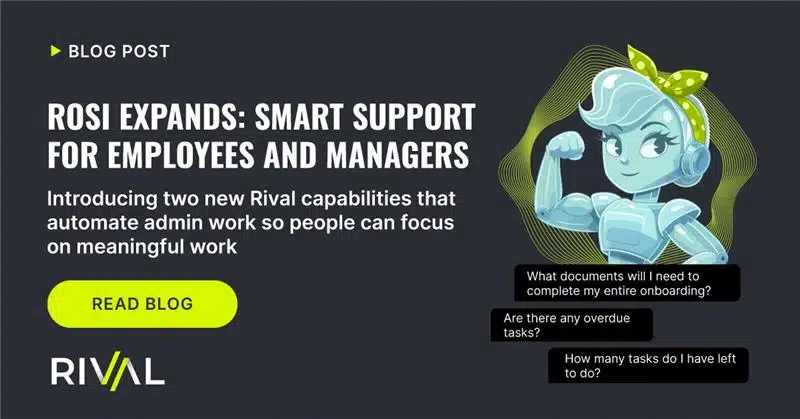
You already know ROSI as the intelligence behind Rival, handling candidate sourcing, screening, and workflow automation. With two new capabilities — ROSI Employee Agent and ROSI Review Writer — employees get clarity, managers get context, and HR gets time back to focus on impacting culture.
Everyone moves forward faster.
The Hidden Cost of Employee Confusion
A surprising amount of time is lost at work simply because people don’t know what to do next.
Employees trying to navigate key moments such as onboarding, role changes, benefits enrollment, compliance tasks, often run into the same problem: the system tracks the process, but it doesn’t guide the person through it.
So they ask.
- “When is my benefits enrollment due?”
- “What tasks are left in my onboarding?”
- “How do I submit this form?”
These aren’t complex questions. But when answers aren’t obvious, employees stop moving forward. So they wait, they email HR, and they ask their manager. Productivity stalls, not because people lack motivation, but because they can’t figure out what to do next.
The ripple effect spreads quickly. HR teams become the default helpdesk for routine questions. Managers get pulled into administrative guidance instead of coaching their teams. Employees lose time trying to navigate systems that should be supporting them.
Review cycles
reveal another version of the same problem. Managers sit down to write evaluations with a blank page and scattered memories of the past six months. Recency bias creeps in. The most visible accomplishments stand out, while quieter contributions disappear. Thoughtful reviews take hours to assemble when leaders are already stretched thin.
The result isn’t just inefficiency. It’s frustration.
Employees feel uncertain about what’s expected. Managers scramble to assemble feedback at the last minute. HR spends its time answering questions instead of improving programs that support the workforce.
None of this is a talent problem. It’s a clarity problem.
That’s where ROSI changes the experience.
ROSI Employee Agent helps employees get answers and guidance instantly, while ROSI Review Writer brings the right context together so managers can deliver meaningful feedback without starting from scratch.
Instead of chasing information, people can focus on the work that actually matters.
ROSI Employee Agent: Eliminating Daily Friction
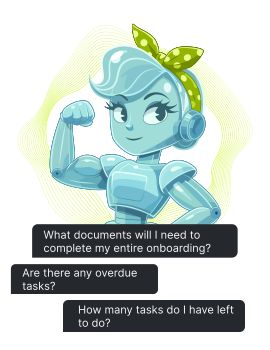
Picture this: An employee four days into onboarding opens the Rival Workflow portal. Instead of hunting through onboarding content or emailing HR, they ask ROSI: “What tasks do I have left to complete this week?”
ROSI responds: “You have three tasks remaining: Complete your I-9 verification (due tomorrow), finish the security training module (due Friday), and schedule your 30-day check-in with your manager (due by end of next week). The I-9 requires your passport or driver’s license and social security card.”
There’s no waiting, no confusion, and no fractured trust when experience matters most.
ROSI Employee Agent gives employees a clear view of what needs to be done now and what comes next. It answers “How do I…?” questions about Rival tools so work keeps flowing.
The intelligence is in the context. ROSI knows where the employee is in their journey, what tasks are assigned to them, what’s completed, what’s pending, and what’s overdue. It’s not pulling from a static FAQ, but responding based on real workflow data for that particular employee.
Now picture this: A manager transitioning to a new department asks ROSI: “What needs to happen before my transition is official?” ROSI pulls up the specific tasks and responds: “You need to complete the department-specific compliance training, meet with your new team lead for role expectations, and submit your access request for the project management tool. Two of these are done. The access request is pending approval from IT.”
The employee doesn’t chase anyone, HR doesn’t have to field the question, and the transition keeps moving.
ROSI Review Writer: Turning Scattered Data Into Structured Feedback
Imagine the following scenario: A manager opens Rival Perform to write a year-end review. Normally this is where the dread sets in: the blank page, the vague memories, the knowledge that this will take two hours minimum (and there are nine more to go).
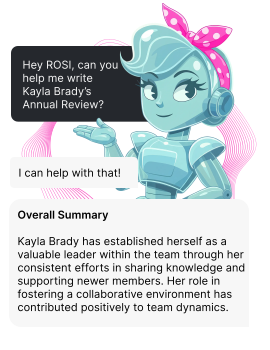
Instead, the manager tells ROSI: “Help me write Kayla Brady’s 2025 annual review.” They add context: “Strong performer, demonstrated leadership during Q3 product launch, needs to work on delegation and managing up.”
ROSI pulls performance data already tracked in Rival Perform (goals completed, notes from check-ins, peer feedback, logged achievements) and generates a structured draft:
“Kayla Brady has demonstrated leadership qualities through her natural ability to share knowledge with newer team members, positioning her as a key leader within the team. Her contributions during the Q3 product launch were particularly notable, coordinating cross-functional efforts and maintaining team cohesion during a high-pressure period. Her goal completion rate of 94% reflects consistent execution.
Moving forward, Kayla would benefit from developing stronger delegation skills. She tends to take on execution herself rather than distributing work across the team, which limits her capacity for higher level strategic thinking. Building more proactive communication with leadership around blockers and resource needs will be important as she takes on larger initiatives.”
The manager reads through the draft. ROSI got the basics right, but it’s missing nuance. The manager knows Kayla’s reluctance to delegate stems from seeing projects mishandled by junior team members in the past, not from a control issue. They refine the language, add context, and personalize the tone. Fifteen minutes later, the review is done and it’s better than what they would have written from scratch in two hours.
ROSI doesn’t replace the manager’s judgment. It gives them a head start so they can spend time refining instead of staring at a blank page, trying to remember what happened last year. The draft is grounded in real performance data, not generic templates.
The same applies to the employee side: normally, self reviews hang over employees’ heads as they struggle to remember what they’ve accomplished. Add in the pressure to advocate for themselves, highlight achievements without sounding boastful, and translate daily work into business impact.
ROSI helps articulate employee contributions clearly, transforming “I did my job” into concrete examples of impact. Similar to manager reviews, ROSI pulls in performance data that’s already tracked in Rival Perform and generates a structured draft, meaning employees don’t start from zero. ROSI supports both sides of the conversation, eliminating the most time-consuming and anxiety-inducing parts of review cycles, leading to productive feedback that drives growth and development.
How It Compounds: When the System Remembers
Individual capabilities get more powerful when signals carry across the employee journey.
Activity in Rival Workflow feeds directly into performance insights in Perform. There’s a record of when an employee completes onboarding tasks, hits their 30-day milestones, and navigates a role transition. When review time comes, no one is scrambling to remember what happened. ROSI already has it ready to go.
Check-ins and feedback throughout the year become raw material for review drafts. Continuous input means no end-of-year surprises. And recognition happens in real time, not just during formal cycles.
Employees complete tasks on time because they have context. Performance conversations feel fair because they’re based on documented activity, not the someone’s ability to remember who did what.
HR and leaders get capacity back. Time that used to go to process management now goes to coaching and strategy. Better data improves talent decisions (promotions, development plans, succession planning).
Guardrails: Keeping Humans in Control
ROSI operates within boundaries designed to keep humans in control and data secure.
While ROSI can draft reviews, the writer will always have the final say. Additionally, Review Writer never publishes feedback automatically so managers or employees can decide what goes into the final review and when it gets shared. Fairness checks prevent ROSI from generating inappropriate commentary or recommending HR actions like termination, discipline, or PIPs. If a manager prompts ROSI that direction, it redirects them toward professional, work-focused feedback.
Employees will always know what data is feeding their reviews. The Source & Evidence section shows exactly what information contributed to the draft pulling from previous goals, check-ins, and feedback. If something feels off, they can follow it back to the source.
Data privacy is non-negotiable. ROSI uses a Retrieve-Augment-Generate (RAG) architecture, pulling from real-time data without embedding customer-specific information into the model. We don’t use customer data to train or fine-tune models at Rival. PII is never transmitted, processed, or stored by the AI. Responses are generated dynamically from retrieval, not from learned patterns in your organization’s information.
This architecture means ROSI complies with GDPR, CCPA, EEOC, and other frameworks. Security and compliance are built in, not bolted on.
Systems That Support People
The introduction of ROSI Employee Agent and ROSI Review Writer isn’t about adding more AI to HR tech. It’s about leveraging HR tech to eliminate friction points for employees, managers, and HR.
With ROSI Employee Agent and ROSI Review Writer, Rival is embedding intelligence directly into the employee journey — so people spend less time navigating processes and more time doing the work they were hired to do.
That’s what it means to make work flow.